
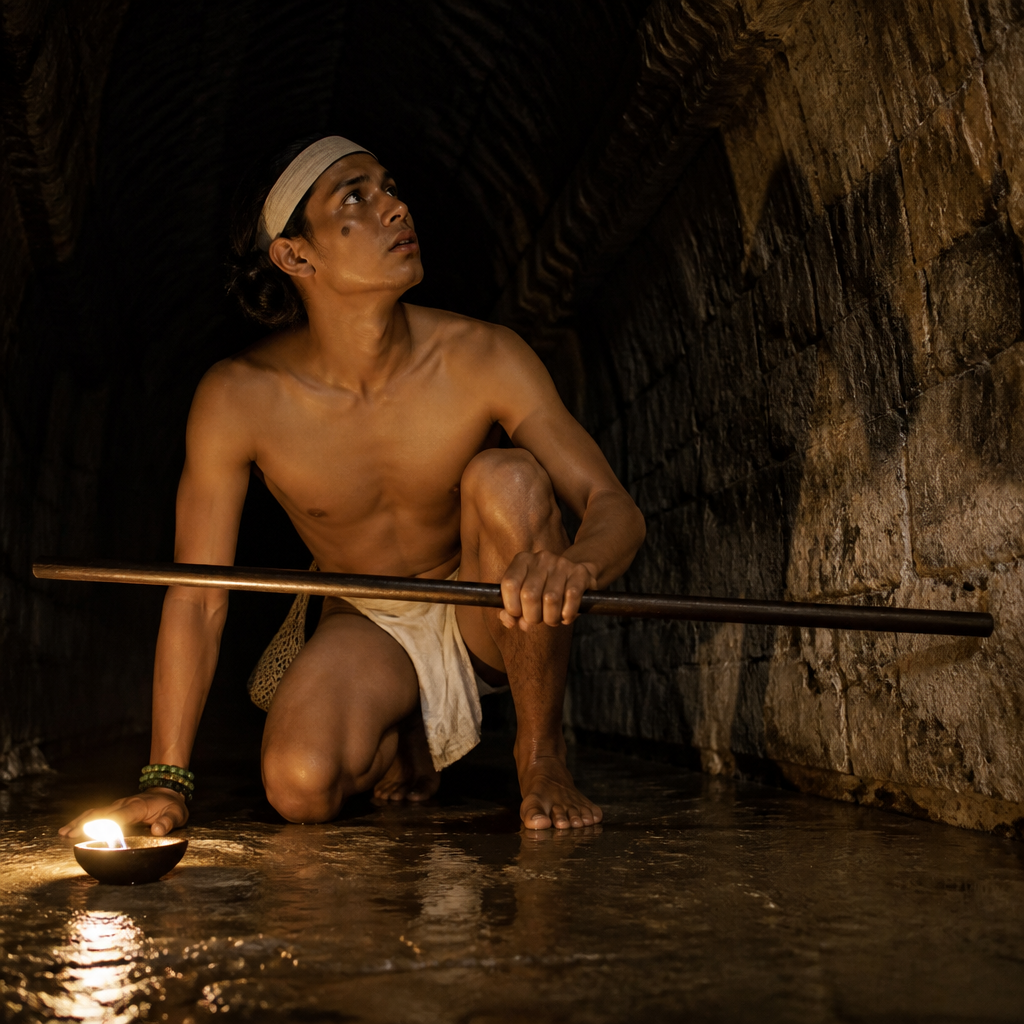
Hunahpu
Also Known As: K’iche’ Junajpu; elder of the Hero Twins of the Popol Vuh, son of Hun Hunahpu and Lady Blood; in Classic Maya art the same figure appears as Hun Ajaw
Region/Culture: Mesoamerica and the Caribbean
Mythos: Mayan Mythology
Primary Type/Nature: Heroes and Mortals
Mythical Attributes: He is the better shot and the worse improviser of the two brothers, and the only one of them to lose his head and get it back.
Role in Mythos: With his brother Xbalanque he goes down into Xibalba, survives its houses of trial, is beheaded, is restored, and finally destroys the lords of death by tricking them into asking to be killed.
Relation to Humans: He is not worshipped so much as counted: his name is one of the twenty days of the K’iche’ calendar, and it is the day set aside for the dead, when families go to the graves with food and flowers and incense. The Popol Vuh has the twins institute that practice themselves, at their own father’s burial place.
He goes to look for the dawn, which is exactly the wrong thing to do inside a house full of bats. The two brothers have spent the whole night shut in their blowguns while the bats crash and squeal above them, and now things have gone quiet, and Hunahpu crawls up to the muzzle of his to see whether the light has come. It has not. Something in the dark takes his head off at the neck. His brother, three feet away, asks him twice whether he can see the dawn, and gets no answer, and hears nothing but wings.
Hunahpu is the elder of the two boys the K’iche’ Maya called the Hero Twins, and his story is the longest sustained narrative in the Popol Vuh, the book written down in highland Guatemala in the middle of the sixteenth century by K’iche’ lords who had just watched their world end. It was not invented then. Painted pots made between six hundred and nine hundred years earlier, from the lowlands hundreds of miles away, show these same episodes, which means the story was already old and widely known when the manuscript preserved it.
His own name is a small puzzle that a century of scholarship has not fully settled. It has usually been rendered One Blowgun Hunter, on the assumption that the last syllable is a clipped form of the word for blowgun, and he certainly is a blowgun hunter in the text. The trouble is that the scribes who wrote the Popol Vuh spell blowgun differently everywhere else in the book, and his father is called Hun Hunahpu, which under that reading would mean One One Blowgun Hunter. The likeliest answer is that the name was simply his name, kept in an old spelling because that is how it had come down.
The family situation is the reason for everything that follows. His father and uncle were ballplayers, loud ones, and they played on the road that leads down to Xibalba until the lords of death lost patience and summoned them. Both men failed the tests, were sacrificed, and the father’s head was hung in a calabash tree, which promptly fruited for the first time. A daughter of one of the lords came to look at the tree. The skull spoke to her, asked her to hold out her right hand, and spat into it. She was pregnant when she left, and that saliva is Hunahpu.
He grows up in the upper world alongside his brother, badly treated by two older half-brothers who are turned into monkeys for it, and eventually the brothers find their father’s ballgear in the rafters and start playing, and the summons comes for them exactly as it came for their father.
They do better, mostly because they cheat. At the crossroads of four coloured roads they send a mosquito ahead to bite each of the seated lords in turn so that they call each other by name and give the whole roster away. They recognise the carved wooden dummies set among the lords to make them look foolish. They keep the torch and cigars alight all night by fitting them with macaw tail feathers and fireflies. They survive the House of Darkness, the Shivering House with its frost and howling wind, the House of Jaguars, the House of Blades.
Then the House of Bats, and the head.
What happens next is the part that stays with people. The Xibalbans hang the head over the ballcourt and use it as a ball. His brother makes him a temporary one out of a squash, sends a rabbit into the tomato patch to bounce away like a ball at the right moment, and in the confusion swaps the squash for the real head. The game is finished with a vegetable, and nobody notices.
The brothers know by now that they cannot win the tests, because the tests are not designed to be won. So they arrange their own deaths on their own terms. Told what the lords intend, they jump into the pit oven themselves, hand in hand, and the Xibalbans celebrate and grind their bones and scatter the powder in the river, which is precisely what the brothers had asked two seers to tell them to do.
Five days later two ragged strangers are performing in the villages, dancing the Whippoorwill and the Weasel and the Armadillo, burning a house down and putting it back up whole. Their best trick is that one kills the other and then brings him back. Word reaches the lords, who send for them, watch the act, and then, being lords, want it done to them.
Hunahpu and his brother oblige. They kill One Death, and they do not bring him back. They kill Seven Death, and they do not bring him back. Then they announce who they are, and the lords of Xibalba, who had never had to plead for anything, plead.
His powers are the ones a hunter has and the ones a corpse does not need. He shoots straight. He endures. Above all he can be killed and keep going, which is not resurrection in the usual sense so much as a refusal to accept the terms offered: he goes into the oven rather than be pushed, and comes out of the river as something the Xibalbans do not recognise.
His limits are just as clear, and the book is not sentimental about them. He is beaten by every trap that requires cleverness in the moment rather than preparation. He is defeated at the crossroads, defeated by the torch and the cigars, and killed in the House of Bats by putting his head out of a hole, which is not a sophisticated mistake. Every recovery in his story is arranged by somebody else. What he supplies is the willingness to go back down.
At the end the two of them rise into the sky as the central lights, one as the sun and the other as the moon, and the four hundred boys killed by a monster earlier in the book come up behind them and become a constellation. The Popol Vuh does not say which brother took which light.
Frequently Asked Questions
Who is Hunahpu in Maya mythology?
Hunahpu is one of the Hero Twins of the Popol Vuh, the K’iche’ Maya creation book, and the elder brother of Xbalanque. Together they descend into the underworld of Xibalba, survive its houses of trial, and destroy the lords of death. He is the son of Hun Hunahpu and of Lady Blood, a daughter of one of those lords.
How was Hunahpu conceived?
His father’s severed head was hung in a calabash tree in Xibalba. A young woman named Lady Blood came to look at the tree, and the skull asked her to hold out her right hand and spat into it. She was pregnant with Hunahpu and Xbalanque when she left, and the text says the children were created in her womb by the saliva alone.
How did Hunahpu lose his head?
In the House of Bats, he and his brother spent the night hiding inside their blowguns. When the bats fell quiet, Hunahpu crawled to the muzzle to look for the dawn and a death bat cut his head off. The Xibalbans hung the head over the ballcourt, and Xbalanque replaced it with a carved squash until he could recover the real one using a rabbit as a decoy.
How did the Hero Twins defeat the lords of Xibalba?
They arranged their own deaths, jumping into a pit oven, and had their ground bones scattered in the river, from which they returned. Disguised as ragged travelling performers, they made a name for an act in which one killed the other and revived him. When One Death and Seven Death asked to be killed and revived themselves, the twins killed them and stopped there.
What does the name Hunahpu mean?
It has usually been translated as One Blowgun Hunter, and he is a blowgun hunter in the story, but the reading is doubtful. The scribes of the Popol Vuh spell the word for blowgun differently everywhere else in the book, and his father’s name Hun Hunahpu would then mean One One Blowgun Hunter. It is probably simply an old proper name kept in an archaic spelling.
Related Entries
Xbalanque, Xibalba, Camazotz, Zipacna, Ah Puch, Itzamna, Ix Chel, Kukulkan, Alux, Mictlan, Mictlantecuhtli, Quetzalcoatl, Tezcatlipoca