
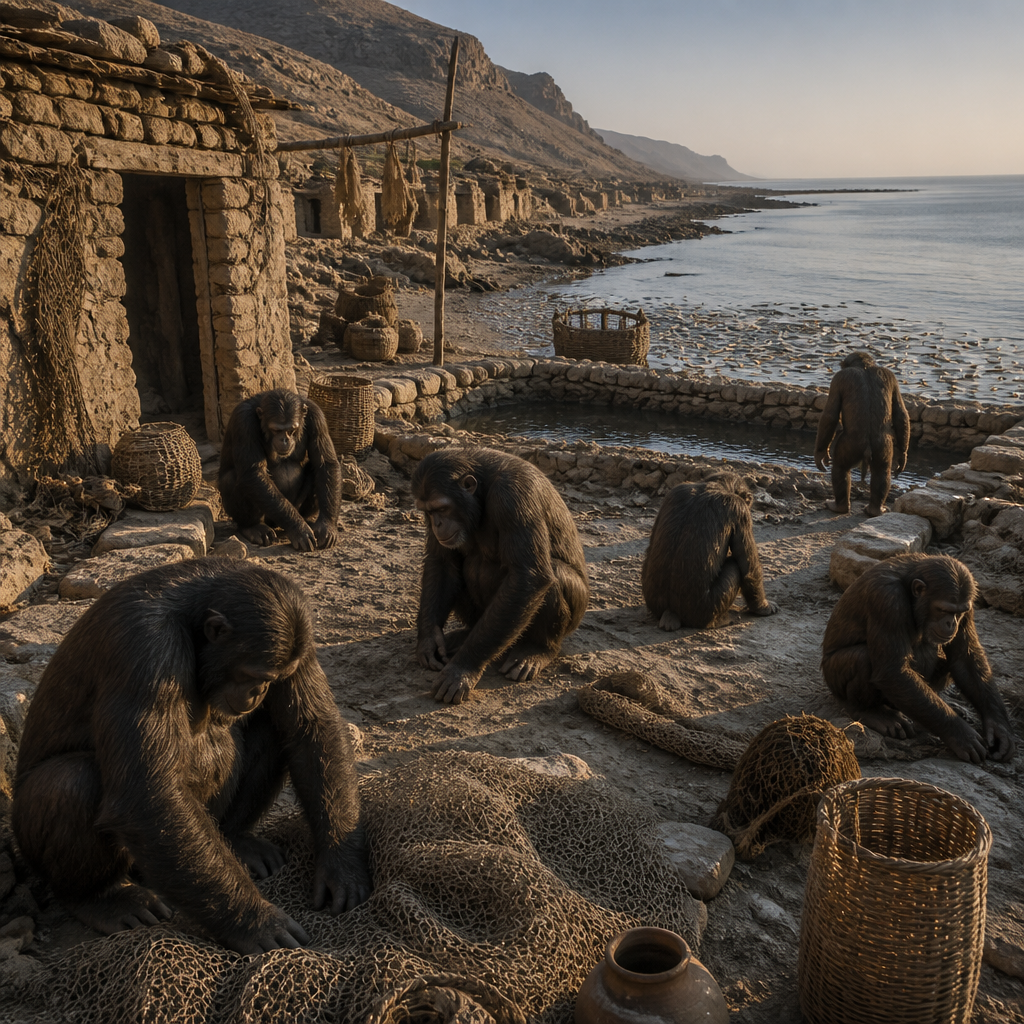
Dead Sea Apes
Also Known As: also the People of the Sabbath, Ashab al-Sabt
Region/Culture: West Asia/Middle East
Mythos: Islamic Mythology, Jewish Mythology
Primary Type/Nature: Undead/Cursed Beings
Mythical Attributes: A community of Israelite fishermen transformed into apes by God as punishment for evading the Sabbath through trickery.
Role in Mythos: They stand as scripture’s enduring example of divine punishment for those who keep the letter of a sacred law while betraying its purpose.
Relation to Humans: They were human themselves, ordinary townspeople whose greed turned them into a warning for everyone who came after. Their fate is invoked as a deterrent rather than encountered as a creature.
The fish came to the town on Saturdays, and they came wrong. On the other six days the catch was ordinary, scarce enough that a man earned his supper. On the seventh, the one day the people were forbidden to fish, the sea turned generous past all sense. The shallows went silver and crowded, fins breaking the surface within reach of a child leaning off the rocks, the water so thick with them it seemed to lean back against the shore. The smell of them carried up the lanes. Everyone understood what they were looking at. It was a test, and it was not subtle.
The town was Aylah, or somewhere like it, a fishing settlement of stone houses and reed drying-racks on a warm northern gulf. The stories disagree on which sea. The English name fixes them by the Dead Sea, while the older commentaries put them on an arm of the Red Sea, near the head of the gulf where the desert runs down to the water. What the sources agree on is the people. They were Israelites, bound by a law given in the time of the prophet David: keep the Sabbath, set the seventh day aside, and on it take nothing from the sea.
For a while they obeyed, and resented it, and watched a fortune swim past every week. Then someone found the loophole. A man would wade out on Friday afternoon and sink his nets, or dig a channel and a holding pool at the tide line so the Saturday fish would swim in and strand themselves behind a low wall of stones. He touched nothing on the Sabbath. He simply let the day do the work and came back on Sunday to lift a catch that had caught itself. His hands were clean. His conscience, he decided, was clean too.
The trick spread the way a clever excuse always spreads. Soon much of the town was fishing without fishing, prosperous and pleased with itself. The people split into three. There were the ones who worked the loophole. There were the ones who were appalled and said so, who warned in the market that a law evaded is still a law broken, and who, when no one listened, drew apart to live in their own quarter so as not to share the roofs of the guilty. And there was a third group in the middle, who did not fish on the Sabbath but did not stop those who did, who asked the warners why they bothered scolding men already doomed. The warners gave an answer that has outlived all of them: so that we have something to say when we are asked.
The punishment came in the night. The town woke to find the loophole-fishers changed. Their bodies had been twisted into another shape, the spine bent, the face pushed forward and coarsened, the hands turned to something between a hand and a paw. They had become apes. The accounts are oddly silent on the particulars, on colour or size or sound, as if the horror were the fact of it rather than the look. They knew their own kin. The transformed creatures are said to have recognized the relatives who came to the doors of their houses, pressing against them, weeping, unable to form a single human word.
This kind of transformation has a name in the tradition, maskh, the divine unmaking of a form, and it carries hard rules. The changed do not breed. They found no line of ape-people who go on living in the hills. They last only a few days, three by most tellings, and then they die. The Dead Sea Apes left nothing behind. No descendants, no colony, no second act. The point was never a new species. The point was the lesson, and the lesson needed the witnesses, the warners who had moved to the clean quarter and woke to find themselves spared, standing among the stranded nets and the stone pools while their neighbours died as beasts around them.
The scripture returns to them more than once, which is part of how they work. They appear as a finished example, a thing the audience is assumed to already know: remember the ones who transgressed the Sabbath, to whom it was said, be apes, despised. The line is meant to be quoted at a wavering conscience. They are less a story to be discovered than a sentence to be remembered, held up whenever someone reaches for a clever way around a plain command.
What the story turns on is not a monster’s strength but a community’s cleverness, and the limit that cleverness ran into. The loophole worked perfectly. The nets filled, the pools held, the letter of the law went untouched, and none of it mattered, because the law had never been about the mechanics of who lifted which fish on which day. As for the silent third group, the ones who neither sinned nor stopped the sinners, the text says what became of the guilty and what became of those who forbade the wrong, and then it goes quiet. It does not say whether the watchers were saved. Readers have noticed the silence ever since, and felt it land where it was meant to.
Frequently Asked Questions
What are the Dead Sea Apes?
The Dead Sea Apes are a community of Israelite fishermen who, in the Quran, were transformed into apes by God as punishment for breaking the Sabbath. They are also known as the People of the Sabbath, or Ashab al-Sabt, and are remembered as a cautionary example rather than as a living species of creature.
Why were they turned into apes?
They were punished for evading the Sabbath through trickery. Forbidden to fish on Saturday, they set nets and dug holding pools on Friday so that the fish would trap themselves, then collected the catch on Sunday, obeying the letter of the law while deliberately defeating its purpose. The transformation was a punishment for that deceit.
Where does the story of the Dead Sea Apes come from?
The story is told in the Quran, most fully in Surah Al-A’raf (7:163-166) and referenced in Surah Al-Baqarah (2:65-66), Surah An-Nisa (4:47), and Surah Al-Ma’idah (5:60). Islamic commentators such as Ibn Kathir locate the events in a coastal town, often identified as Aylah near the head of the Red Sea gulf, in the time of the prophet David. The tradition also has roots in earlier Israelite and midrashic material.
What happened to the three groups in the town?
The townspeople divided into three: those who broke the Sabbath, those who openly condemned them and moved away, and a silent middle group who disapproved but did nothing. The transgressors were transformed into apes, and the warners were explicitly saved. The fate of the silent group is left unstated, a deliberate gap that has prompted centuries of discussion.
How long did the Dead Sea Apes survive after the transformation?
According to most accounts, the transformed people lived only about three days before dying. In Islamic doctrine such divinely transformed beings, called maskh, do not reproduce or endure, so the apes left no descendants and formed no lasting population.
Related Entries
Djinn, Ifrit, Ghoul, Nasnas, Dajjal, Lilith, Golem, Nephilim, Lycaon, Niobe, Arachne, Callisto, Cadmus