
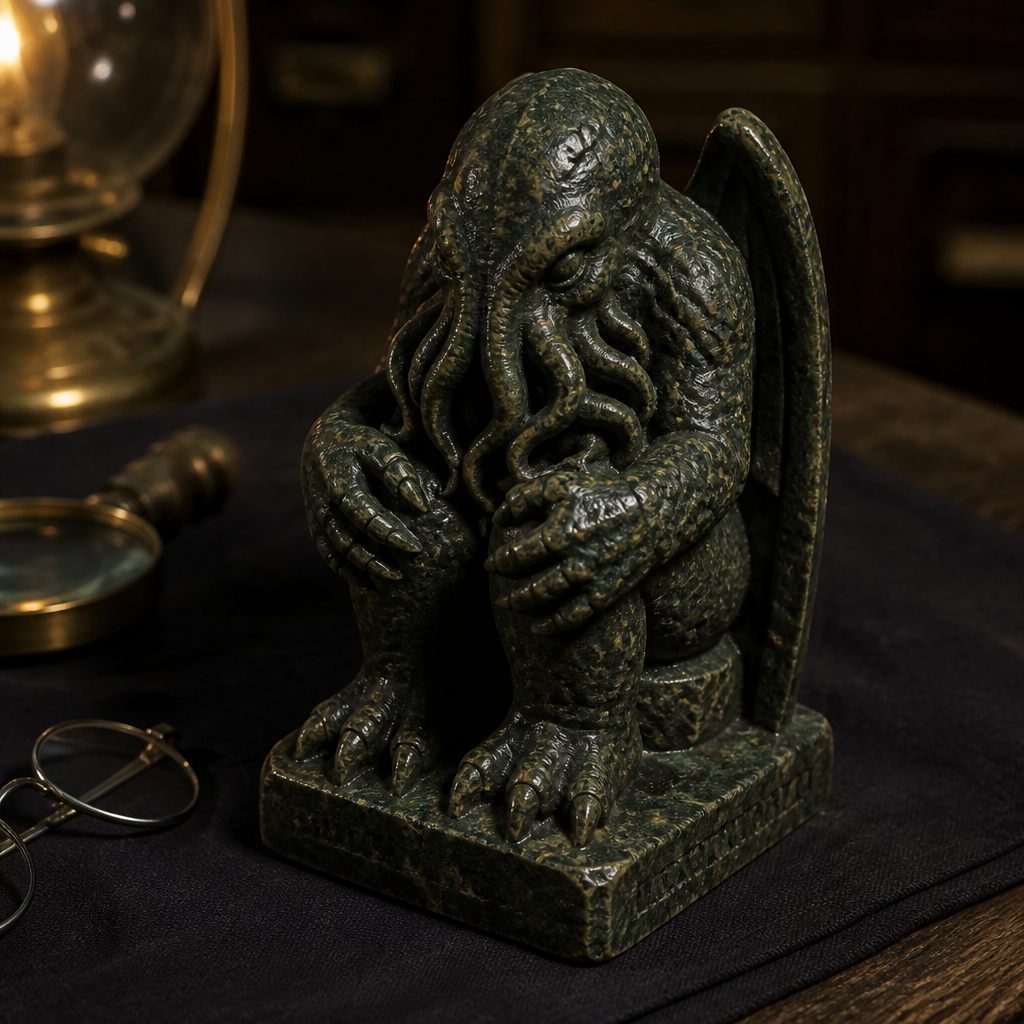
Cthulhu
Also Known As: also Khlûl’-hloo in H. P. Lovecraft’s own transcription; called great Cthulhu, the great priest of the Great Old Ones, and the Thing in R’lyeh
Region/Culture: North America
Mythos: Literary Mythology
Primary Type/Nature: Gods and Deities
Mythical Attributes: He is a mountain-sized being of star-born matter who is dead and not dead at once, who broadcasts his will into the dreams of sensitive minds, and whose body reassembles itself after it is destroyed.
Role in Mythos: He is the great priest of the Great Old Ones, entombed in the sunken city of R’lyeh, holding his fellows in preserving sleep until the stars come round to the right positions and the world can be taken back.
Relation to Humans: A secret cult of sailors, swamp-dwellers and Greenland shamans keeps his memory alive with chanted rites and hanging sacrifices, waiting to liberate him. To everyone else he is a pressure behind the eyes during a bad spring, a run of shared nightmares, an architect screaming in an asylum.
The idol was between seven and eight inches high, and every scientist in the room wanted to put it down.
It had come to the 1908 meeting of the American Archaeological Society in St. Louis in the luggage of a New Orleans police inspector named Legrasse, who had no interest in archaeology at all and simply wanted to know what it was. The men passed it hand to hand. The stone was soapy to the touch and greenish black, shot through with golden flecks and striations, and it matched nothing in geology or mineralogy that any of them could name. Around the base ran characters that half the world’s expert learning could not place in any language family. What made it unbearable was not the strangeness. It was that the thing looked alive.
A monster of vaguely anthropoid outline, but with an octopus-like head whose face is a mass of feelers. A scaly, rubbery-looking body. Prodigious claws on hind and fore feet, and long, narrow wings behind. It squats on a rectangular pedestal, bloated and corpulent, the wingtips grazing the back edge of the block and the curved claws of its doubled-up hind legs gripping the front and hanging a quarter of the way down. The cephalopod head is bent forward so that the ends of the facial feelers brush the backs of the huge fore paws clasping its raised knees. It is a posture of waiting, and it is the only pose in which Cthulhu is ever shown at rest.
He is a modern invention, and it is worth saying so plainly. Howard Phillips Lovecraft wrote “The Call of Cthulhu” in August and September of 1926 and sold it to *Weird Tales*, which ran it in the issue of February 1928. It is the only story in which the creature really appears. Everything after that, including the very phrase “Cthulhu Mythos”, which Lovecraft’s correspondent August Derleth coined and applied to the shared body of work, is elaboration by other hands.
Inside the fiction, his origin is older than the planet’s crust and considerably worse. Cthulhu and the Great Old Ones came down out of the sky when the earth was young, brought their own images with them, and built cities of Cyclopean stone whose remains still lie as blocks on Pacific islands. They were not made altogether of flesh and blood. They had shape, but the shape was not matter, and when the stars stood wrong they could not live. So they died, in the sense that anything that never really dies can die, and lay down in stone houses in their great city of R’lyeh, kept whole by Cthulhu’s own spells against the day the sky came right again. The couplet an old mestizo cultist quoted to Legrasse from the *Necronomicon* of the mad Arab Abdul Alhazred puts it better than any gloss: *That is not dead which can eternal lie, and with strange aeons even death may die.*
The chant is the same in Louisiana as it is on the West Greenland ice. *Ph’nglui mglw’nafh Cthulhu R’lyeh wgah’nagl fhtagn.* In his house at R’lyeh dead Cthulhu waits dreaming. On the night of 1 November 1907, twenty New Orleans policemen splashed for miles through cypress swamp toward a red glare and the beat of tom-toms, past ugly roots and hanging nooses of Spanish moss, and came out at a grassy island where a hundred naked celebrants circled a ring-shaped bonfire. At the centre stood a granite monolith eight feet high with the little green idol on top of it, and around the outside hung ten scaffolds bearing the marked bodies of squatters who had gone missing. Four of the policemen reeled. One fainted. Legrasse threw swamp water in his face and they went in shooting.
What the cult was waiting for arrived by accident, and arrived from Dunedin. In March 1925 an earthquake heaved a mountaintop of R’lyeh above the Pacific, and the crew of a captured yacht called the *Alert* went ashore on it out of nothing worse than curiosity. The geometry was wrong; a surface that looked convex proved concave at the second glance, and no one could be certain the sea was horizontal. A Portuguese sailor found a carved door the size of a barn, and one of the men pressed his way along the moulding until the acre-wide lintel gave inward at the top and swung open on a balance. The dark inside came out like smoke, visibly staining the sun, and something in it went off on flapping membranous wings. The smell was intolerable. Then a quick-eared man heard a slopping sound down there, and It squeezed its gelatinous green immensity through the doorway into the open air.
A mountain walked. Three men were swept up by the flabby claws before anyone thought to run, and a fourth was swallowed by an angle of masonry that was acute and behaved as though it were obtuse. Two reached the boat. Gustaf Johansen got steam up on the *Alert*, turned her about and drove her bow straight into the pursuing bulk as the squid head with its writhing feelers came up over the bowsprit. There was a bursting as of an exploding bladder, a slushy nastiness as of a cloven sunfish, a stench as of a thousand opened graves. For an instant the ship was blind in a green cloud. Astern, in the seething, the scattered plasticity was already drawing back together into its original shape, losing ground only because the yacht was gathering speed.
That is the whole of his recorded power, and it is enough. He kills by contact and by proximity, and men die near him with no wound and no cause a physician can name. He speaks by moulding dreams, because transmitted thought is the only language that reaches the fleshly minds of mammals, and when he stirs the sensitive feel it worldwide: sculptors modelling his likeness in their sleep, poets waking in terror, one architect going permanently insane on the exact night the door opened. He is not malicious in any way a person would recognise. He simply intends to resume, and human beings are in the room.
His limits are stranger than his abilities. He is hostage to astronomy, unable to live at all when the stars stand wrong, and unable to move even when they are right until some outside force breaks the seal on his tomb; the spells that keep him intact are the same spells that pin him down. Deep water cuts off his broadcast, which is why the sinking of R’lyeh silenced him for aeons. His body can be ruptured by a steam yacht at full speed, though only briefly, and he needs the city above water to come out of it at all. When the sea closed over R’lyeh again after the storm of 2 April 1925, the dreams stopped everywhere at once and the Pacific went back to being ordinary.
The story’s horror is not evenly distributed, and modern readers notice it: Lovecraft loads the cult onto sailors, immigrants and mixed-race squatters with a contempt that is his own and not the cosmos’s. The idea underneath survived him anyway, which is the odd part. A being with no plan for humanity, no interest in humanity, and no reason to notice humanity has proved more durable than any devil with a grudge. Cthulhu is now a plush toy, a card game, a bumper sticker. The plush toy is also seven or eight inches high, squatting, with its knees drawn up.
Frequently Asked Questions
Who is Cthulhu?
Cthulhu is a colossal star-born entity invented by the American writer H. P. Lovecraft, who called him the great priest of the Great Old Ones. He lies entombed in the sunken city of R’lyeh beneath the Pacific, neither properly alive nor properly dead, waiting for the stars to return to the right positions. He first appeared in Lovecraft’s story “The Call of Cthulhu”, published in *Weird Tales* in February 1928.
What does Cthulhu look like?
Cthulhu has the rough outline of a man, an octopus-like head whose face is a mass of feelers, a scaly and rubbery bloated body, enormous claws on all four limbs, and long narrow wings folded behind him. The description comes from a small green-black stone idol seized by New Orleans police in 1907, in which he squats on a pedestal with his knees drawn up and his facial tentacles brushing his forepaws. When he is finally seen in the flesh, witnesses describe a gelatinous green immensity the size of a mountain.
What does “Ph’nglui mglw’nafh Cthulhu R’lyeh wgah’nagl fhtagn” mean?
Cult members translated the phrase as “In his house at R’lyeh dead Cthulhu waits dreaming.” It is the only part of the cult’s ritual that is ever spoken aloud, and identical versions of it were recorded independently among Louisiana swamp worshippers and among a Greenland shamanic cult, which is what convinced investigators that the two groups shared one religion. The genuine secret of the cult was never the chant; that was only whispered.
Can Cthulhu be killed?
No. Cthulhu was rammed at full steam by the yacht *Alert* and burst like a bladder, but his scattered substance began recombining into its original form within seconds. He is described as never really dying even when the stars are wrong and he cannot live; his body is shape rather than matter. The only thing that has ever stopped him is the sea closing back over R’lyeh and sealing him in his stone house.
Why does Cthulhu appear in people’s dreams?
Transmitted thought is the Great Old Ones’ natural mode of speech, and moulding dreams is the only way their language can reach human minds. When R’lyeh rose above the water in the spring of 1925, artists and poets across the world dreamed of a dripping Cyclopean city with impossible geometry; one sculptor modelled Cthulhu’s likeness in his sleep and one architect went mad. Deep water blocks the signal, so the dreams stopped the moment the city sank again.
Related Entries
Nyarlathotep, Azathoth, King in Yellow, Hound of Tindalos, Morlocks, Mbwun, Kraken, Akkorokamui, Lusca, Leviathan, Tiamat, Cetus, Polyphemus