
Coraniaid
Region/Culture: Northern Europe (Wales)
Mythos: Welsh Mythology, Celtic Mythology
Primary Type/Nature: Fairy Folk and Spirit Beings
Mythical Attributes: A race whose hearing was so acute they could catch any word the wind touched, which made any plot or attack against them impossible.
Role in Mythos: They are the first of the three plagues that afflict Britain during the reign of King Lludd in the tale of Lludd and Llefelys.
Relation to Humans: They settled among the Britons as an unconquerable oppression, immune to force because no scheme against them could be kept secret. They were destroyed only when King Lludd found a poison that worked on them but spared his own people.
A man on the road home leans toward a friend and drops his voice to a whisper, then thinks better of it and says nothing at all, because even the shape of a plan is too much. Somewhere downwind, ears he will never see have already taken it in. This was Britain under the Coraniaid, where the moving air worked against you and a secret had the lifespan of a single breath.
They arrive without warning in the Middle Welsh tale of Lludd and Llefelys, one of three afflictions that fall on the island while Lludd, son of Beli, holds the kingship and builds the stronghold that would grow into London. The Coraniaid are the first and in some ways the worst, because the other two plagues can at least be confronted. The Coraniaid cannot. Their hearing was so sharp that any sound the wind carried reached them, which meant no army could be raised, no ambush laid, no counsel held, without the plan travelling to the very people it was meant to undo. They could not be fought because they could not be surprised.
The stories that preserve them are oddly indifferent to what they looked like. There are no faces here, no garments, no reckoning of their number, only the single overwhelming fact of what they could do. The one thread to pull is the name itself, which sits close to the Welsh corrach, meaning dwarf, and its adjective corachaidd, stunted or dwarfish. That likeness has led readers to imagine a small, swarming people, but the tale will not confirm it. The Coraniaid are defined entirely by an ability rather than a body, an enemy reduced to a single dreadful sense.
Where they came from shifts depending on who is telling it. One of the old Triads of the Island of Britain, which clearly looks back to this same story, lists them among the Three Oppressions that came to Britain and never left, and says only that they came from Asia. Later hands tried to fasten them to real history. The translator Sioned Davies points out that the name may simply mean the Romans, who in Welsh could be called Cesariaid, and notes that other triads count the three plagues of Britain as the Coraniaid, the Goidelic Picts, and the Saxons, a roll call of genuine invaders. A forged set of triads from the early nineteenth century, the work of Iolo Morganwg, had them settle near the Humber and join the Romans and Saxons against the Britons, and one Victorian translator went further and tied them to the lost otherworld of Annwn. The language does not bear the weight of these guesses. What survives cleanly is the medieval tale, and in it the Coraniaid are less a nation than a problem with no obvious solution.
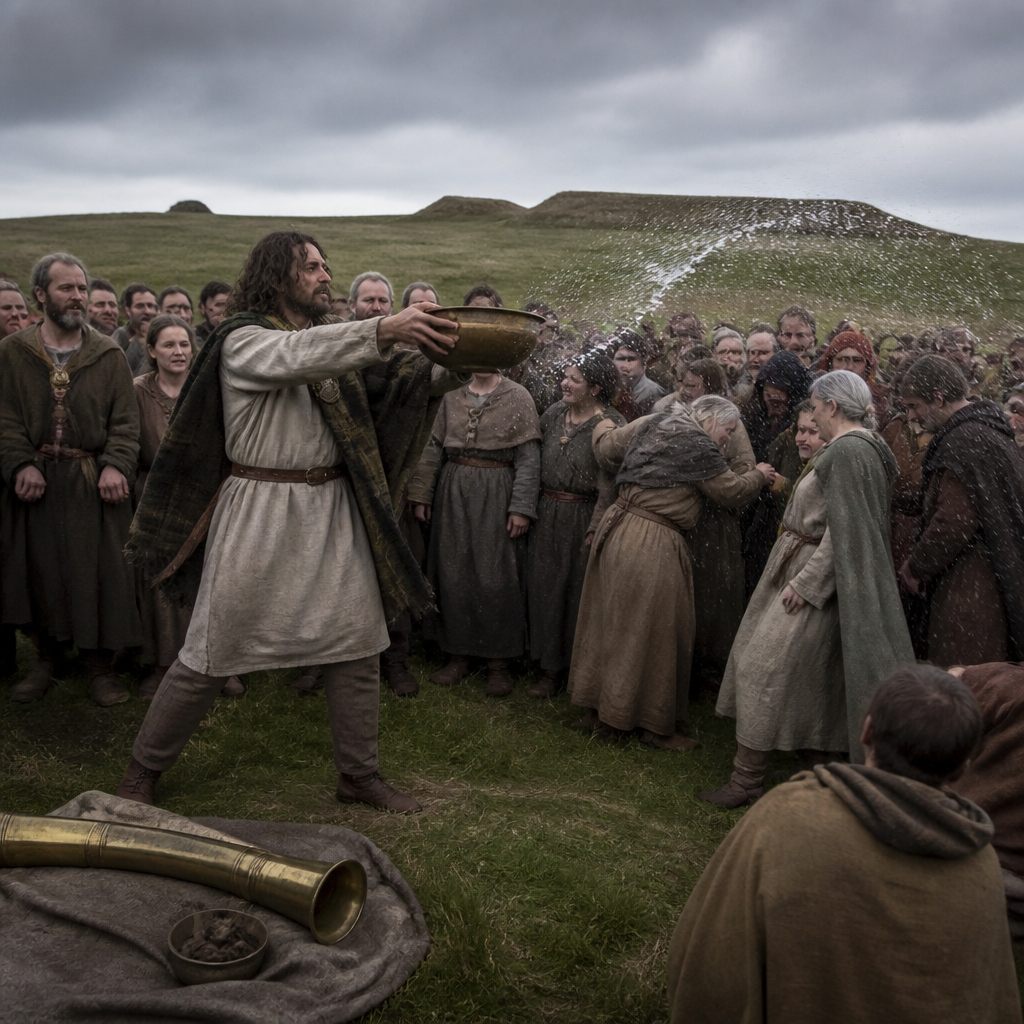
The trouble for Lludd was that he could not even ask for help out loud. So he took his fleet across to his brother Llefelys, who had married into the kingship of France, and the two of them spoke through a long horn of brass held between their mouths, so that whatever passed inside it would not reach the listening air. Even that nearly failed. Every word came out of the horn twisted into its opposite, friendly speech arriving as insult, until Llefelys understood that a demon had got into the brass and was fouling the message. He had wine poured through the horn to wash the thing out, and only when the metal was clean could the brothers finally hear each other plainly.
The cure, once it could be spoken, was almost humble. Llefelys gave his brother a certain insect, to be crushed and steeped in water, deadly to the Coraniaid and harmless to any Briton. Lludd carried it home, bred up enough of the creatures to make the dose, and then did the one thing his enemies could never guard against. He called both peoples together as if for an assembly, the Britons and the Coraniaid mingled in a single crowd, and flung the water across all of them at once. His own people stood there wet and unharmed. The Coraniaid did not stand at all. Careful man that he was, Lludd kept some of the insects back to breed, in case the affliction ever returned.
Their power was knowledge before the fact, and it was close to absolute. Nothing could be plotted against a people who heard the plot in the making, and for as long as the danger had to be spoken or signalled or marched, they were untouchable. The flaw was hidden inside that same gift. Their hearing shielded them from words and from armies, from everything that announced itself, but not from a quiet thing slipped into a crowd that no one had to discuss. A cup of water did what no army could. The very completeness of their advantage was the place they never thought to watch, because the move that killed them was the one move too soft to overhear.
Frequently Asked Questions
Who were the Coraniaid?
The Coraniaid were a race of beings in Welsh mythology who appear in the tale of Lludd and Llefelys, preserved in the Mabinogion. They came to Britain as the first of three plagues during the reign of King Lludd and could not be driven out, because their hearing was so sharp that they detected any word the wind carried.
What made the Coraniaid impossible to defeat?
The Coraniaid had hearing so acute that they could hear any sound the wind touched, so no plan against them could be kept secret. Any attempt to raise an army or set a trap reached their ears before it could be carried out, which is why King Lludd had to find a way to act against them that required no spoken scheme at all.
How were the Coraniaid finally destroyed?
King Lludd’s brother Llefelys told him of a certain insect that, crushed and mixed with water, was deadly to the Coraniaid but harmless to the Britons. Lludd summoned both peoples to a single assembly and threw the mixture over the entire crowd, killing the Coraniaid while leaving his own people unhurt. He kept some of the insects to breed in case the plague ever returned.
Why did Lludd and Llefelys speak through a horn?
Lludd could not discuss the Coraniaid openly because they would overhear any plan, so he and Llefelys conferred through a long brass horn that kept their words from reaching the air. According to the tale, a demon got into the horn and twisted their speech into insults until Llefelys had wine poured through it to drive the demon out, after which the brothers could finally talk freely.
Were the Coraniaid based on real invaders?
Some traditions suggest the Coraniaid were a memory of real invasions. The translator Sioned Davies notes that the name may stand for the Romans, and other Welsh triads list the three plagues of Britain as the Coraniaid, the Goidelic Picts, and the Saxons, all historical peoples who entered Britain.
Related Entries
Tylwyth Teg, Coblynau, Gwyllion, Cyhyraeth, Afanc, Pwyll, Bucca, Knocker, Nuada, Pixie, Brownie, Dwarf, Goblin, Kobold, Gnome