Chilean Mythology: The Complete Guide to Battling Serpents, Sea Witches, and the Spirits of Chiloé
In 1880, the government of Chile put witchcraft on trial. Not metaphorically — there was a courtroom, a prosecutor, sworn testimony, and roughly eighty defendants. They were the leadership of La Recta Provincia, a secret society of brujos who claimed to operate a shadow government over the island of Chiloé, complete with its own laws, its own tribunal, and a fortress-cave at Quicaví guarded by a monster they had manufactured from a stolen child. The trial convicted dozens and formally banned the organization. Chilean mythology is the only body of folklore where the gods and monsters were cross-examined under oath, in a republican courtroom, within living memory.
That is the first thing to understand: this is not a dead mythology recovered from temple walls. It is a living, contested, intensely local tradition, and it is not even a single mythology. It is a collision. On the mainland sits the cosmology of the Mapuche, the great unconquered people of southern Chile who fought Inca and Spaniard alike to a standstill. To the south, across cold channels, lies the Chiloé archipelago, where Mapuche, Huilliche, and Chono beliefs fused with the Catholicism of Spanish settlers into a dense maritime folklore unlike anything else in the Americas. Where Greek myth was frozen into canon by Hesiod and Homer, Chilean myth stayed oral, stayed wet, and stayed dangerous.
Because there is no ancient written scripture, the sources are unusual: the transcripts of the 1880–1881 witch trials; the pioneering ethnography of Francisco J. Cavada, whose Chiloé y los chilotes (1914) first catalogued the island’s legends; the oral tradition kept alive by the Mapuche machi (shaman-healers); and the storytelling of fishing villages where the Caleuche is still something you simply do not talk about after dark. This guide treats all of it as one connected world, because on the ground, it is.
What Makes Chilean Mythology Different
The myths went on trial — and lost. No other mythology has a documented court case where the state prosecuted its supernatural order. The Recta Provincia operated like a parallel republic of sorcerers, and when governor Martiniano Rodríguez moved against it in 1880, the testimony entered the public record. Historians now read the trial as a clash of two worldviews and possibly as a form of indigenous Huilliche resistance to colonial authority. The supernatural here is not ancient — it is recent, political, and was once considered a law-enforcement problem.
The geography is the unhealed wound of a war between two snakes. The Chiloé archipelago — its islands, channels, and drowned valleys — is explicitly the leftover battlefield of Trentren-Vilu and Caicai-Vilu, the land serpent and the sea serpent. They never finished their fight; the sea never fully receded. Every earthquake and tsunami along this coast — and this is one of the most seismically violent places on Earth — is read as the two serpents resuming combat. The map is a myth in progress.
The sea is the protagonist, not the backdrop. Inland mythologies treat the ocean as an edge. Here it is the center of everything: the source of fertility and famine, the highway of the Caleuche ghost ship, the home of the Pincoya whose dance decides whether the nets come up full. To anger the sea is to starve. The afterlife itself is maritime.
The monsters are manufactured, not born. The signature horror of Chiloé is artisanal. The Imbunche is not a species — it is a single infant abducted by warlocks and deliberately deformed over years into a cave guardian. The Camahueto is harvested. The Basilisco Chilote is hatched on purpose. Evil, in this tradition, is a craft with techniques.
The supreme god is four people at once. The Mapuche creator Ngenechen is not a sky-father but a fourfold being — an old man, an old woman, a young man, and a young woman simultaneously. Divinity here is balanced across age and gender by design, a quaternity rather than a patriarch, which makes Mapuche theology strikingly unlike the Mediterranean and Norse pantheons most readers know.
The Major Gods and Powers
The Mapuche High Powers
Ngenechen — supreme creator and sustainer of the Mapuche. He is embodied as four persons at once (old man, old woman, youth, maiden), governing the harmony between the natural and supernatural worlds. After contact he absorbed the title Chaw Dios, “Father God,” blending indigenous and Christian authority without ever quite becoming the Christian deity.
Pillan — the great ancestral fire-spirits, the deified souls of chiefs and warriors who dwell in the upper world and speak through volcanoes and thunder. Pillan is a power of the east, the sacred direction; the most powerful of them fathered the serpents whose battle made the world.
Antü — the sun, the chief celestial entity, emblem of strength, wisdom, and rightful leadership. He anchors the moral geography of the cosmos, rising in the good and powerful east.
Kueyen — the moon, Antü’s consort and counterpart. Where Antü rules the day and order, Kueyen presides over the night, the tides, and the rhythms of the female and the sea — a pairing that keeps the cosmos in gendered balance.
The Serpent Powers
Trentren-Vilu — the benevolent serpent of the land, son of Antü, lord of earth, mountains, and every creature that walks. In the great flood he lifted the ground and raised the hills to save humanity. He is protector, but his protection is the reason the mountains exist.
Caicai-Vilu — the serpent of the sea, son of the rival Pillan, master of all marine life. Enraged at human ingratitude, he hammered the ocean into a world-drowning flood. He is not simply evil; he is the sea’s just fury, and he never fully lost.
Spirits of Place and Sea
Ngen — the “owners,” guardian spirits that hold dominion over specific natural things: a spring, a wood, a stone, a stretch of river. To take from nature without acknowledging its Ngen is theft, and the Ngen collects. This is Mapuche ecology rendered as living law.
Pincoya — a luminous sea spirit with long golden hair, dressed in kelp, who dances on the shoreline and beneath the waves. Daughter of the sea-god Millalobo, she is the fertility of the ocean made flesh: if she dances facing the sea, the catch will be abundant; if she faces the shore, scarcity follows.
Creatures, Monsters, and Supernatural Beings
Made Things and Guardians
Imbunche — the most disturbing creature in the canon. The brujos steal a firstborn infant, then over years twist its body: the head wrenched backward, one leg fused to the spine, the skin cured, the tongue split so it can only shriek. The result guards the entrance to the witches’ cave. It is horror as a slow craft, and it is the dark mirror of the loved child.
Basilisco Chilote — the Chilote basilisk, hatched from the egg of an aged rooster, with a bird’s body and a serpent’s tail. It nests beneath the floorboards of a house and drains the breath and life from the sleeping family until they waste away. To kill it you must burn the house. It localizes a European import into a uniquely domestic terror.
Camahueto — a calf-sized creature with a single crystalline horn, born in the rivers and bogs of Chiloé. Its horn is potent magic, and a machi who can capture a young Camahueto and shave its horn gains a powerful healing charm — but a full-grown one tearing toward the sea will gouge a ravine through the land as it goes.
Shapeshifters and Night-Flyers
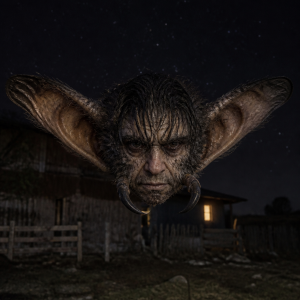
Chonchon — a flying head. A powerful sorcerer can detach his own head, which sprouts enormous ears that beat like wings, and fly through the night crying tué tué tué. Heard but unseen, the Chonchon is one of the most feared omens in both Chilean and Argentinian folklore.
Peuchen — a shapeshifting, blood-drinking serpent that can take the form of a flying snake and paralyze prey with its gaze. It drains livestock and people alike; only a machi can counter it. The Peuchen is the closest thing the Andes have to a true vampire.
Nguruvilu — the “fox-snake,” a river creature with the body of a serpent and the head of a fox, whose tail ends in a claw. It creates deadly whirlpools at fords to drown those crossing, then devours them. Travelers paid the river-crossing toll in fear of it.
Fire, Forest, and the Edges of the House
Cherufe — a humanoid of living rock and magma that dwells in the lava pools of Chilean volcanoes. Earthquakes and eruptions are its hunger; in older tradition it was appeased with human sacrifice, the victim hurled into the crater. It is the volcano given a will.
Trauco — a squat, powerful forest goblin of Chiloé, no more than three feet tall, dressed in quilineja vines and carrying a stone axe he taps against the trees. His gaze and his breath enchant young women into helpless dreams. For generations, the Trauco was the explanation offered for an unmarried woman’s unexpected pregnancy — a myth doing very real social work.
Colo Colo — a creature hatched, like the basilisk, from a degenerate egg; in Mapuche tradition a rat-serpent whose presence sickens a household, drinking the saliva and life of those who sleep nearby. Small, hidden, and patient, it is domestic dread distilled.
Beyond these lurk the truly obscure: the Fiura, the Trauco’s foul-breathed female companion who withers crops and drives men mad with desire; La Voladora, a woman who vomits up her intestines to fly as the witches’ nighttime messenger; and the Wekufe, the broad class of malevolent spirits a sorcerer summons to do harm — the raw material of curses.
The Central Myths
The Battle of Trentren and Caicai
In the beginning the people lived on a broad coastal plain. One morning Caicai-Vilu, the sea serpent, judged that humanity had grown ungrateful for the ocean’s bounty, and in fury he slammed his vast tail against the water, raising a flood to swallow the land. The people fled uphill, crying out to Trentren-Vilu, the land serpent, who answered by heaving the earth upward — raising hills and mountains faster than the water could climb, and teaching the people to carry their dead and to make offerings to survive. The two serpents fought for an age. Trentren won, but only barely: the waters never sank back to where they had been. What was left — the peaks turned to islands, the valleys turned to channels — is the Chiloé archipelago itself.
Why it matters: This is simultaneously a creation myth, a flood myth, and a geological explanation, and it is still active. Chileans living on one of the planet’s most earthquake-prone coasts inherited a story that frames every tremor as a cosmic struggle rather than a catastrophe — a worldview that turns terror into meaning.
The Caleuche and the Cave of Quicaví
By night a brilliantly lit ship glides through the Chiloé channels, ringing with music and laughter: the Caleuche. It is crewed by the drowned and commanded by the brujos of the Recta Provincia, the witch society whose headquarters was the great cave at Quicaví, guarded by the Imbunche. The ship trades in wealth and secrets, rewards those who serve the warlocks, and abducts those who see too much. Witnesses who try to watch it are said to have their heads twisted around or their mouths sealed.
Why it matters: The Caleuche fuses an indigenous afterlife — the dead carried away across the water — with the very real, documented secret society of Chilote sorcerers. It is the rare legend with a paper trail in a courtroom, and it shows how Chiloé’s people encoded social power, fear, and the fate of the drowned into a single luminous image on the night water.
The Trauco and the Unexplained Child
Deep in the Chiloé forest the Trauco watches young women. His look alone is said to overpower them, drawing them into a sweet, helpless sleep in which he has his way; a woman so visited wakes remembering nothing. When an unmarried girl found herself pregnant, the community had a ready and blameless answer: the Trauco.
Why it matters: Stripped of its enchantment, this is a myth performing social surgery — a culture’s mechanism for absorbing pregnancies outside marriage without ruin or accusation. It reveals how folklore can function as moral infrastructure, protecting the vulnerable by relocating responsibility onto the supernatural.
Afterlife and Cosmology
Mapuche cosmology stacks the universe into vertical planes in perpetual tension. At the top is Wenu Mapu, the upper land, home of Ngenechen, the Pillan ancestor-spirits, and the forces of creation and purity. Below it lies Nag Mapu, “the land we walk on,” the contested middle world where humans, animals, and spirits mingle and where good and evil forces wrestle for the upper hand. Beneath everything is Minche Mapu, the lower world of the Wekufe and destructive powers. Life is the act of keeping balance among the three.
This is mapped onto the kultrun, the machi’s sacred drum, whose face is painted with a cross that quarters the world into the four cardinal directions — each a season, a color, and a moral charge. East and south, where Antü rises, are good and powerful; north and west are associated with decline and harm. To orient oneself correctly is a spiritual act, and Mapuche dwellings and rituals face the sacred east accordingly.
The Chilote afterlife runs on a different current. Here the sea takes the dead, and the Caleuche gathers the drowned to crew its decks in an endless luminous voyage — neither heaven nor hell but a glittering continuation under the command of the brujos. To die at sea in Chiloé was not simply to end; it was to be recruited. The boundary between the living, the dead, and the bewitched stays porous, patrolled by the machi, who alone can read the signs and push the Wekufe back.
How Chilean Mythology Connects to Other Traditions
The Andean substrate. Before the Spanish, the Inca pressed south into central Chile, and beneath Mapuche belief runs the broader Andean current carried by figures like Viracocha, the great Andean creator. The flood-and-remaking pattern of Trentren and Caicai rhymes with the world-destruction-and-renewal cycles found throughout Incan mythology, suggesting a shared deep grammar of catastrophe and survival across the Andes.
The cross-Andean Mapuche world. The Mapuche were never confined to Chile; their cousins, the Pehuenche and others, ranged across the mountains into Argentina, carrying the same beings. The Chonchon flies through Argentinian mythology as readily as Chilean, and Argentine folk monsters like the Hombre Gato share the same nocturnal, rural register of fear.
The European graft. Spanish colonization did not erase the indigenous gods; it grafted onto them. The Basilisco Chilote is the medieval European basilisk relocated under a Chilote floor. The brujos’ Recta Provincia borrowed the structure of European witch-cult panic, while the Christian devil fused with the indigenous Wekufe. Chilean mythology is one of the clearest living laboratories of religious syncretism anywhere.
The universal flood. Two serpents drowning and remaking the world places Chilean myth in conversation with the flood narratives of Mesopotamia, Greece, and the Hebrew Bible — but with a distinctive twist: here the flood is never fully undone, and its scars are the everyday landscape.
Where to Start Reading
There is no single ancient text, so the best entry point is the ethnographic record. Francisco J. Cavada’s Chiloé y los chilotes (1914) remains the foundational catalogue of island legend, and Julio Vicuña Cifuentes’ Mitos y supersticiones gathered Chilean folklore in the same era. For the Mapuche side, the writings of contemporary Mapuche authors and the recorded testimony of the machi carry the tradition more faithfully than any colonial summary.
For English readers, the documented history of the Recta Provincia witch trials is the most vivid doorway — the Smithsonian’s reporting on “the cave of Chile’s witches” is an accessible introduction, and Bruce Chatwin brushes against this world in In Patagonia. Approach all of it knowing that the people of Chiloé still tell these stories as warnings, not curiosities — which is exactly what keeps them alive.
Explore Chilean Mythology on Gods and Monsters
Gods and Monsters currently hosts 6 dedicated Chilean entries, woven into the wider web of Mapuche, Chilote, and Andean beings they share their world with. Browse all Chilean Mythology entries →
Ngenechen · Trentren-Vilu · Caicai-Vilu · Pillan · Antü · Kueyen · Ngen · Pincoya · Caleuche · Imbunche · Trauco · Camahueto · Basilisco Chilote · Cherufe · Chonchon · Peuchen · Nguruvilu · Colo Colo · Alicanto · Wekufe
Frequently Asked Questions
What is the main mythology of Chile?
Chile has no single mythology but two great interlocking traditions. The Mapuche religion of the mainland centers on the fourfold creator Ngenechen, the ancestral Pillan, and a layered cosmos. The Chilote folklore of the Chiloé archipelago blends those Mapuche and Huilliche roots with Spanish Catholicism into a sea-soaked world of the Caleuche, the Trauco, and the witch-society of the brujos. Most “Chilean myths” people know come from Chiloé.
What is the legend of the two serpents in Chile?
It is the Mapuche flood and creation myth. Caicai-Vilu, the sea serpent, raised a flood to punish ungrateful humanity; Trentren-Vilu, the land serpent, raised the mountains to save them. Their endless battle left the waters higher than before, and the drowned valleys and peaks became the islands of Chiloé. Earthquakes and tsunamis are believed to be the serpents fighting still.
Is the Chiloé witch society real?
The legend is rooted in fact. La Recta Provincia, also called La Mayoría, was a real secret organization of brujos that allegedly governed and judged in Chiloé between the 18th and 20th centuries. In 1880–1881 the Chilean authorities tried roughly eighty of its members for crimes including illegal justice and murder, convicting many. The mythological version adds the Caleuche, the cave at Quicaví, and its Imbunche guardian — but the courtroom was real.
What is the Trauco and why was the legend created?
The Trauco is a short, powerful forest goblin of Chiloé who enchants young women in their sleep. Beyond the scare, the legend served a social function: it provided a blameless explanation for the pregnancy of an unmarried woman, protecting her and her family from shame. It is a clear example of folklore acting as a community’s moral and social tool, not just entertainment.
How is Mapuche religion different from Inca or Aztec religion?
Unlike the centralized state religions of the Inca and Aztec, with their pyramids, priesthoods, and mass sacrifice, the Mapuche kept a decentralized, household- and community-based faith led by the machi, a healer-shaman often female. Their creator Ngenechen is a gender-balanced quaternity rather than a sun-king’s patron god. The Mapuche also famously resisted conquest by both the Inca and the Spanish, so their religion was never absorbed into an imperial cult.
What is the Caleuche ghost ship?
The Caleuche is a luminous phantom ship that sails the channels of Chiloé by night, full of music and light, crewed by the drowned and captained by the brujos. It serves as a kind of maritime afterlife — the sea’s dead are taken aboard — and as the witches’ vessel for trade, reward, and abduction. Those who watch it too closely are said to be punished, which is partly why, in Chiloé, you simply do not speak of it after dark.