
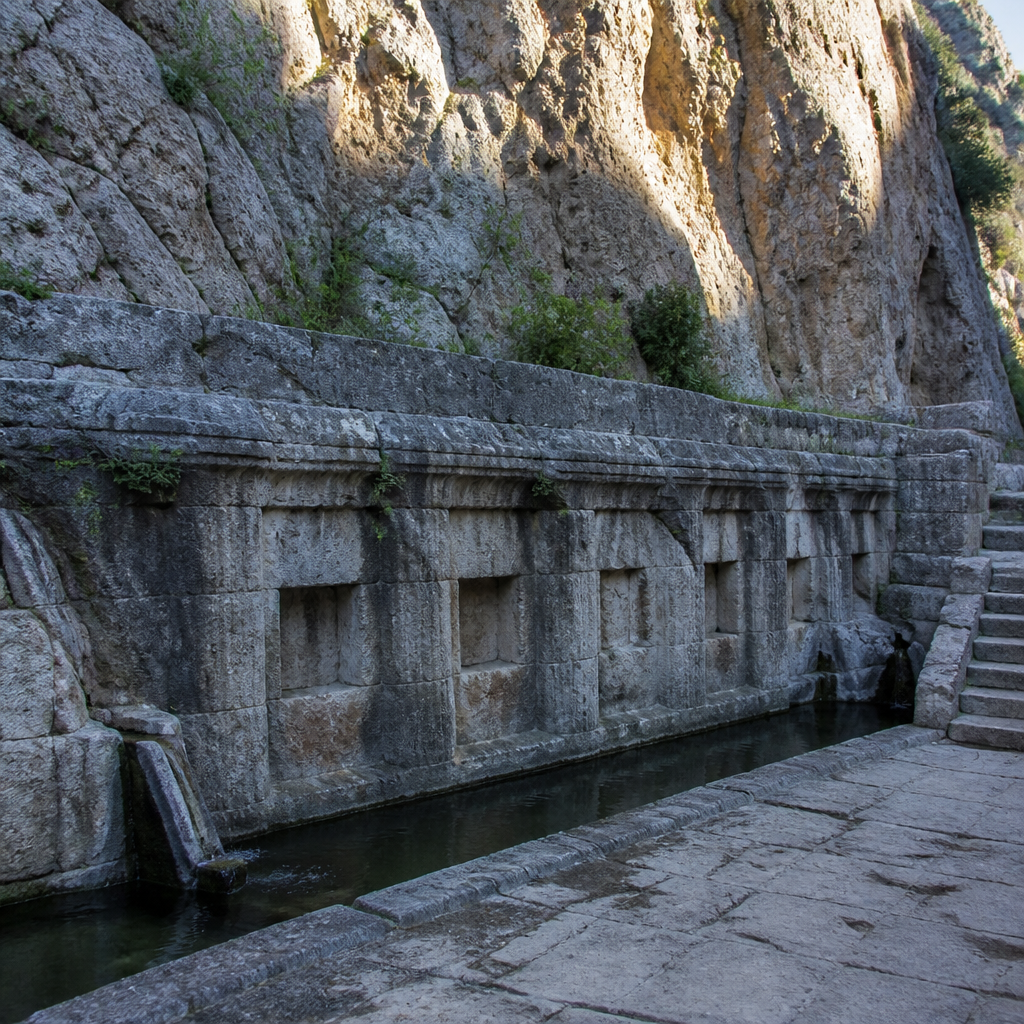
Castalian Spring
Also Known As: Greek Kastalia, also written Kastalian Spring; the naiad of the same name is Castalia, Kastalia
Region/Culture: Southern Europe
Mythos: Greek Mythology
Primary Type/Nature: Mythological Places
Mythical Attributes: Its water cleansed whoever was about to approach Apollo at Delphi, and was carried up to wash the floor of his temple.
Role in Mythos: It is the threshold of the Delphic sanctuary, the last stop before the road turns up towards the oracle.
Relation to Humans: Everyone who came to consult the oracle washed here first, and Euripides has the temple servants say that rinsing the hair was enough for an ordinary visitor while a murderer had to wash all of himself. Pausanias, who drank it, thought it sweet and pleasant to bathe in, and travellers were still carrying bottles of it away in the twentieth century.
The water comes out of the rock cold enough to ache in the fingers, and it does it in shadow, because the ravine it falls into is closed on both sides by cliffs and gets the sun for only a few hours. Those cliffs are pale grey limestone and they take the light hard, which is why the Greeks called them the Phaedriades, the Shining Ones. The eastern one, Hyampeia, comes down almost sheer. Between them the stream collects, crosses under the road that climbs to the sanctuary of Apollo, and goes on down through the olives to join the Pleistos in the valley. Anyone walking up to the oracle at Delphi went past it. Almost nobody went past it without stopping.
Euripides puts the routine on stage. In the Ion, the Delphian attendants are sent to the eddies of Castalia to wet themselves and then to carry the water back and throw it over the floor of the god’s house, and the chorus insists on the state they have to be in when they do it, holy, and clean of women. That is a working instruction, not a poetic flourish. A visitor who had only travelled needed to wet his hair. A man with a killing behind him had to go into the water entirely.
Picture the ordinary version. A traveller who has walked up from the harbour at Cirrha kneels at the basin with the dust of the road still grey in his hair, cups both hands, and takes the shock of the cold on his scalp and the back of his neck, then sits on the stone bench until his breathing settles and his turn comes.
The Delphians built for that traffic early. Around 600 to 590 BC a stone fountain went up beside the road itself: a basin lined with marble, benches along the walls, and a short aqueduct feeding bronze spouts cast as lions’ heads, so the water left the cliff and arrived in a mouth. It was patched and rebuilt for something like five hundred years. In the first century BC the Delphians gave up on the roadside building and went into the cliff instead, fifty metres further along, cutting the whole thing out of the soft native rock. That later fountain is the one visitors photograph now: a reservoir ten metres long hewn into the bedrock, seven metal spouts along a facade dressed with half columns, and a paved forecourt eleven metres by three and a half, reached by eight steps cut down into the stone.
Above the basin the masons hollowed out niches, and the niches were not decorative. Pilgrims left small figures in them for the nymph of the water. Nothing has been recovered from the spring itself, so what stood in those hollows is known only from the shape of the hollows and from what people did at comparable springs, but the habit is plain enough: you took the water, you left something for whoever gave it. Much later, under Ottoman rule, one of the three big niches was squared off into the apse of a small church for Saint John the Baptist, which is a tidy piece of continuity for a place whose entire function was washing people before they went in.
Where the name came from was already an argument in antiquity. Pausanias, walking up in the second century AD, reports that some said the spring was named for a local woman and others for a man called Castalius, and then quotes the epic poet Panyassis, who made her a river god’s daughter and wrote of Heracles that, “crossing with swift feet snowy Parnassus he reached the immortal water of Castalia, daughter of Achelous.” Pausanias had heard a rival version too, from Alcaeus, in which the water was a gift to Castalia from the river Cephisus. He thought the strongest support for that came from the people of Lilaea, who on fixed days threw cakes and other prescribed things into the source of the Cephisus, and said that they came up again at Delphi.
None of those stories has Apollo chasing anybody. The version every modern retelling leads with, in which a virgin named Castalia flings herself into the water at the foot of Parnassus to escape the god, is not in Pausanias, not in Alcaeus, and not in Panyassis. It surfaces in a Latin commentary on Statius’ Thebaid attributed to Lactantius Placidus, who was writing around AD 350 to 400, roughly nine centuries after the earliest Greek poet to mention the spring. The story may be older than the book that carries it. There is no way to show that it is.
The gorge had its own resident before Apollo. Local tradition put the lair of Python, the earth-born guardian of the oracle, in that cleft, and the Homeric Hymn to Apollo has the god kill the great she-dragon beside a sweet-flowing spring at Crisa under Parnassus. The hymn does not name the spring. Whoever first decided it meant this one was reading, not reporting.
The famous claim about the water is the one the ancient evidence supports least. Castalia is now shorthand for poetic inspiration, and the Muses were sometimes called Castalides on the strength of it, but that usage is largely Roman and later, the sort of gesture Virgil makes in the Georgics when he says it is a joy to roam heights where no earlier track bends gently down to Castalia. Pindar already used the name to mean simply Delphi. Herbert Parke, who went through every literary mention of the spring, concluded that its ancient job was more practical than that: a place to wash and rest at the end of a hard climb, whose religious weight is genuinely hard to measure. Pausanias is more use here than most of the poets, and what he says is that the inspiring water at Delphi was not this one at all. That was the Cassotis, higher up beside the temple, which was believed to sink underground and come up inside the shrine to move the women who spoke there.
So the spring purifies and it does not prophesy, and the difference between those two things is the whole history of its reputation. Its limits are the limits of any watercourse. An earthquake in 1870 rearranged the flow and the modern visitor is not looking at quite the same cascade the Delphians channelled. The stone has been restored twice in living memory, by Anastasios Orlandos in 1959 and by the French School at Athens in 1977. And the belief in the water outlived the god by a long way: Peter Levi noted that in the 1960s people still held that it was medicinal, and quietly bottled it. Today it runs into a small modern basin below the road, and people going up to the ruins stop and drink it, which is more or less what it was for.
Frequently Asked Questions
What is the Castalian Spring?
The Castalian Spring is a natural spring in the ravine between the Phaedriades cliffs at Delphi in central Greece, about 500 metres east of the entrance to the sanctuary of Apollo. Its water was used to purify pilgrims, priests and the temple itself before anyone consulted the oracle. Two ancient fountain buildings were constructed at it, one about 600 BC and one in the first century BC.
Who was Castalia in Greek mythology?
Castalia was the naiad, or freshwater nymph, of the spring at Delphi. The epic poet Panyassis called her a daughter of the river god Achelous, while Pausanias also records that some people said the spring was named for an ordinary local woman and others for a man called Castalius. The popular story that she threw herself into the water to escape Apollo comes from a late Latin commentary on Statius, written around AD 350 to 400.
Did the Pythia drink from the Castalian Spring?
The Pythia and those consulting her washed at the Castalian Spring, but Pausanias assigns the inspiring water to a different spring, the Cassotis, higher up beside the temple. He writes that the Cassotis sank underground and came up inside the shrine, where it moved the women who prophesied there. Popular accounts often merge the two springs.
Why is the Castalian Spring associated with poetic inspiration?
The association is mainly Roman and later rather than an ancient Greek cult belief. Latin poets used Castalia as shorthand for Delphi and then for poetic inspiration, and the Muses were sometimes called Castalides for the same reason. Herbert Parke, who surveyed every literary reference to the spring, argued that its actual function in antiquity was purification and rest rather than inspiration.
Can you still visit the Castalian Spring?
Yes. The spring is on the road just east of the main archaeological site at Delphi, and both ancient fountains survive, the rock-cut one still showing its long basin, its half columns and the votive niches above it. An earthquake in 1870 changed the flow, and the water now emerges into a small modern basin below the road.
Related Entries
Apollo, Python, Thriae, Eurynomos, Sybaris, Gaia, Themis, Phoebe, Daphne, Dionysus, Heracles (Hercules), Naiad, Potamoi, Muse, Pegasus