
Apis
Region/Culture: North Africa
Mythos: Egyptian Mythology
Primary Type/Nature: Gods and Deities
Mythical Attributes: A living bull worshipped as the bodily vessel of the creator god Ptah, carrying his power of fertility and serving as a speaking oracle.
Role in Mythos: Apis was the sacred bull of Memphis, herald of Ptah in life and joined to Osiris in death as Osiris-Apis, the form that later became Serapis.
Relation to Humans: Egyptians consulted the bull as one of the country’s most trusted oracles, reading answers in the way it moved and the stalls it entered. When it died the whole region went into mourning, and embalmers gave the carcass the same care lavished on a dead king.
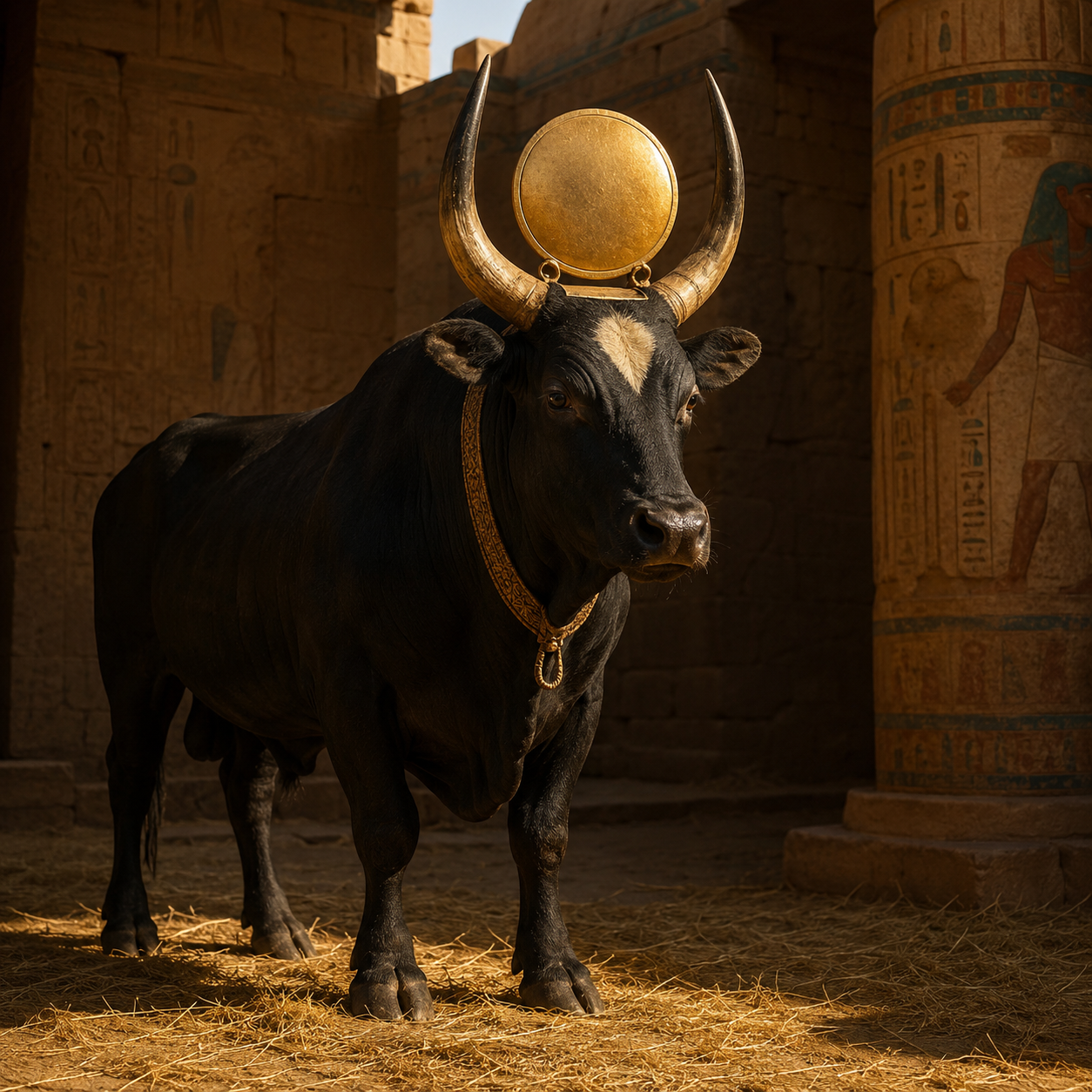
The lamps in his chamber were kept burning so the god would never wake in the dark. He stood in a walled court just south of the great temple of Ptah at Memphis, knee-deep in clean straw, fed on bread and milk and choice grain that ordinary people never tasted, watched at every hour by priests who noted each shift of his weight. He was black across most of his hide, with a wedge of white set high on his brow, and when he swung his head the lamplight ran along horns that curved up toward a disk of beaten gold. Men and women travelled the length of the kingdom to stand near him and put their questions. He answered them by moving.
This was Apis, and he was not a carving or a tale but one particular animal, warm and breathing and chewing, picked out of every herd in Egypt because his body carried the correct marks. The oldest account of those marks comes from the Greek traveller Herodotus, who listed them with the precision of a man copying down a recipe: a black coat, a white square or diamond on the forehead, the figure of a vulture spread across the back, the hairs of the tail growing double, and under the tongue a lump shaped like a scarab beetle. Only one bull in a generation wore the full set. Finding him was the work of priests who searched the country’s cattle, and the moment they found him the divine presence that had drained out of the world at the last bull’s death came rushing back into a single calf.
His mother counted almost as much as he did. The stories say she conceived him not from any earthly bull but from a shaft of light that came down from the sky, a bolt or a beam that quickened her in an instant. She was honoured ever after as the Isis cow, treated as a living image of Hathor, kept apart, and at her own death embalmed and laid in a catacomb of her own. Apis himself was understood as the ba of Ptah, the part of the great craftsman-god that could walk about and be seen and touched. To stand in the bull’s court was to stand in the actual physical company of a creator.
Because the god lived in flesh, he could be asked things directly, and this was the heart of his cult. Petitioners were led to where two stalls stood open, and the stall the bull chose to enter carried the weight of an answer, yes against no, good against ill. His bellow was read as speech. Children who crowded around his pen and caught his breath were said to come away with the gift of foretelling, chanting prophecy in the temple forecourt. A creature that ate hay was, on these days, the most reliable mouthpiece of the divine that Memphis possessed.
The most famous scene in his legend is one that may never have happened. Herodotus tells that the Persian king Cambyses, having conquered Egypt, returned to Memphis to find the city in festival because a new Apis had just been recognised. Taking the celebration as mockery of his own military failures, the king demanded the bull be brought, drew his dagger, and stabbed at its belly, striking the thigh instead and laughing at the priests who worshipped a thing that bled. The bull, in this telling, wasted away from the wound, and Cambyses slid into a madness that ended when he mounted his horse, his own sword slipped from its sheath, and the blade opened his thigh in the very spot where he had struck the god. It is a clean and satisfying story about impiety punished. It is also almost certainly untrue. The sarcophagi dug out of the bulls’ burial vaults show an Apis interred with full honours during Cambyses’ reign, alive and well long after he supposedly killed it. The tale survived because it was useful, a way for Egyptians and Greeks alike to mark a foreign ruler as a man who would knife a god.
What did happen, over and over for more than a thousand years, was the bull’s natural death, and Egypt treated it as a national event. A mourning of seventy days was decreed. The body was carried to the embalmers and worked on for more than two months, packed and wrapped with the attention given to a pharaoh. Then it was drawn in procession across the desert to Saqqara and lowered into the underground galleries called the Serapeum, where it was sealed inside a coffin of granite or limestone. Some of those sarcophagi weigh as much as eighty tonnes, single hollowed blocks the size of small rooms, and the bulls went into them accompanied by silver and amulets. In death the animal stopped being Ptah’s herald and became Osiris-Apis, a god of the dead in his own right. Centuries later, under the Greek kings of Egypt, that fused figure was reshaped again into Serapis, given a human face and a following that spread across the Mediterranean.
His power was never really his own. It was loaned, the borrowed authority of Ptah and then of Osiris, channelled through a body that could be brushed and fed and led on a halter. That was also his limit. The god could die, and did, again and again. Each death left an interval of emptiness while the priests went out across the land to find the next calf with the right markings, a stretch of time in which the most concrete deity in Egypt simply was not there. A bull that needed feeding, that aged, that could drown or sicken or break a leg, made an odd vessel for the eternal, and the Egyptians seem to have known it. They built him a palace anyway, and kept the lamps lit.
Frequently Asked Questions
What was the Apis bull in ancient Egypt?
The Apis bull was a single living bull worshipped at Memphis as the bodily manifestation of the creator god Ptah. It was not a statue or a symbol but an actual animal, chosen from Egypt’s herds for specific sacred markings, and housed in a temple court where it was fed, tended, and consulted as a god.
How was the Apis bull chosen?
Priests searched the country’s cattle for a calf bearing the correct marks, described by Herodotus as a black coat with a white diamond on the forehead, the image of a vulture on the back, doubled tail hairs, and a scarab-shaped mark under the tongue. Only one bull in a generation carried the full set. Its mother was honoured as the Isis cow, believed to have conceived it from a beam of light from the sky.
What happened to the Apis bull when it died?
When an Apis bull died, Egypt observed seventy days of mourning, and the body was mummified with the care given to a dead king. It was then carried in procession to the Serapeum at Saqqara and sealed in a massive stone sarcophagus, some weighing up to eighty tonnes. In death the bull merged with Osiris to become Osiris-Apis.
Did the Persian king Cambyses really kill the Apis bull?
According to Herodotus, Cambyses stabbed the Apis bull in a fit of contempt and was later punished with madness and a fatal wound to the same part of his own body. The story is almost certainly false, because excavated burials show an Apis bull interred with full honours during Cambyses’ reign. The tale survived as propaganda casting the foreign conqueror as a man who would wound a god.
How is the Apis bull connected to Serapis?
After death the Apis bull became Osiris-Apis, a fusion of the bull with the underworld god Osiris. Under the Greek Ptolemaic kings of Egypt, this combined deity was reshaped into Serapis, given a human form and a cult that spread across the Mediterranean world.
Related Entries
Ptah, Osiris, Hathor, Isis, Anubis, Ammit, Maat, Amun-Re, Ra, Horus, Aten, Aker, Bull of Heaven, Cretan Bull, Bai Ze