
Ananke
Region/Culture: Southern Europe
Mythos: Greek Mythology
Primary Type/Nature: Gods and Deities
Mythical Attributes: Primordial personification of necessity, compulsion, and inevitability, whose serpentine coils drive the eternal rotation of the heavens.
Role in Mythos: Entwined with her mate Chronos she split the world egg into its parts at the dawn of creation, and as mother of the Moirai she fixes the allotments that not even the gods can escape.
Relation to Humans: To mortals Ananke is the inescapable constraint behind every fate, the duress that forces hands and closes off choices. Greeks held that she could not be bargained with, and her one known sanctuary, shared with Bia at Corinth, was by custom never entered.
On the high rock above Corinth stood a sanctuary that worshippers walked past. Pausanias, cataloguing the city’s holy places in the second century AD, recorded it with a traveller’s brevity: a shrine of Ananke and Bia, Necessity and Force, into which it was not customary to enter. Every other god in Greece wanted visitors. This one had a door nobody used, and that is the whole theology in miniature. You do not bring offerings to Necessity. She collects regardless.
Ananke is the oldest kind of Greek divinity, a protogenos, one of the powers present before the Olympians, before the Titans, before the world had any shape at all to constrain. Her name was not reserved for temples. It was an ordinary Greek noun meaning compulsion, the everyday word for duress, for the yoke of circumstance, the word Aeschylus reaches for when Agamemnon bows his head and agrees to sacrifice his own daughter so the fleet can sail. When a Greek said ananke, they meant the thing that leaves you no choice. The goddess is simply that thing with a will, or something colder than a will.
The Orphic cosmogonies give her the strangest and most vivid origin story in Greek literature. In the beginning there was water and mud, and the mud solidified into earth. From these two arose Chronos, unaging Time, a winged serpent bearing the heads of a bull and a lion with the face of a god between them. United with him, coiled with him, of his same nature, was Ananke: bodiless yet serpentine, her arms stretched out through the whole universe until her fingers touched its furthest edges. One Orphic fragment makes her the child of Hydros and Gaia, water and earth; the older lyric poet Alcman seems to have known her under the name Tekmor, Ordinance, the end that follows every beginning. She was also called Adrasteia, the Inescapable. The variants disagree on her parentage. None of them imagine anything before her except the unformed dark.
Then comes the act that made the world. Within his boundless coils Chronos generated an egg, and the two serpents wound around it like a wreath and began to tighten. The shell creaked, strained, and split. The fine bright matter floated upward and became Aither, the radiant upper air; the murky remainder spread out as Chaos and misty Erebos; the heaviest, wettest dregs sank and settled into earth and sea. Out of the broken halves came the shining firstborn god Phanes, and the universe had begun. Having cracked creation open, Ananke and Chronos did not rest. They encircled the finished cosmos and set it turning.
They are turning it still. Somewhere past the outermost sphere of the stars the coils slide on through a cold, frictionless dark, and the constellations wheel because of it, slowly, the way a millstone turns. Dawn arrives on time because something without a face insists that it must.
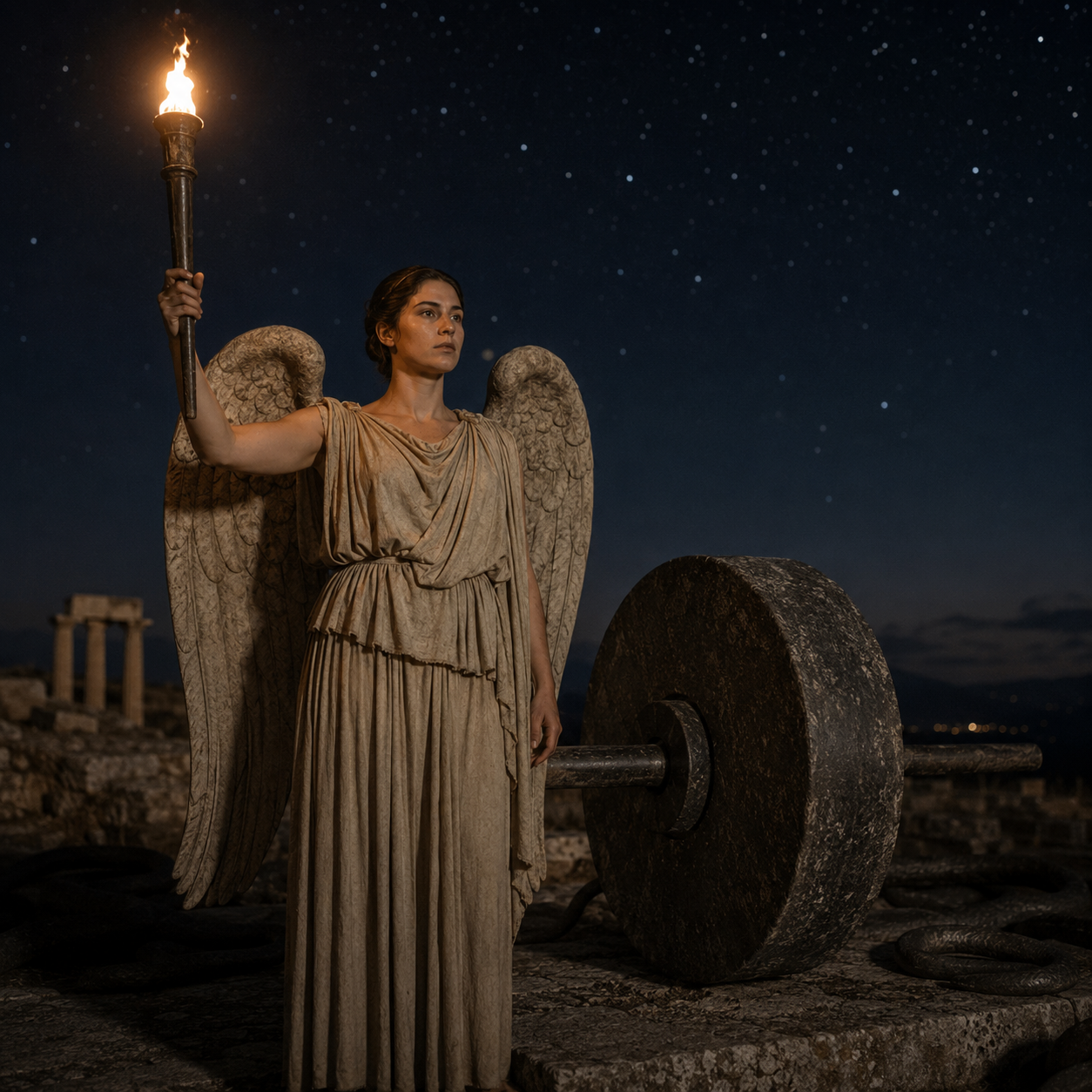
What she looked like is almost unanswerable, and the ancients seem to have felt the difficulty themselves. The texts call her incorporeal yet serpentine, which is less a description than a shrug. A people who painted their gods onto every cup and wall left exactly one surviving image labelled with her name, a winged figure carrying a torch. It is hard to draw the reason things happen.
Plato gave her the most concrete furniture she ever received. In the myth that closes the Republic, a soldier named Er dies in battle, wakes on his own funeral pyre twelve days later, and reports what he saw between worlds: a great spindle of adamant turning on the knees of Ananke, its nested whorls carrying the circles of the planets and stars. Around her, enthroned at equal intervals, sit her daughters the Moirai, the Fates, robed in white with fillets on their heads, singing in unison with the music of the Sirens. Lachesis sings the things that were, Clotho the things that are, Atropos the things that are to be, and between verses their hands keep the spindle turning. Before Lachesis, the souls of the dead choose their next lives, and the choice, once made, is necessity.
The poets kept testing her against the other gods, and she kept winning. In Prometheus Bound the chained Titan says it plainly: skill is weaker by far than Ananke. Who steers her, the chorus asks. The three-formed Moirai and the unforgetting Erinyes, he answers, and even Zeus cannot escape what is foretold. The chorus of Euripides’ Alcestis, having ranged through all poetry and high thought, reports finding nothing stronger than Necessity, and no cure for her in the Thracian tablets of Orpheus or all the remedies Apollo gave to mortals. The proverb collectors boiled it down further: with Necessity, not even gods fight.
Mortals tried to use her anyway. Herodotus tells how Themistocles, fresh from the victory at Salamis, sailed to the little island of Andros demanding money and announced that he came backed by two great gods, Persuasion and Necessity. The Andrians answered that their island already housed two unserviceable gods who refused to leave, Poverty and Helplessness, and that Athens’ power could never be stronger than their inability. They didn’t pay.
Her power is the broadest in Greek myth: she compels the turning of the heavens, the passage of time, the allotments of every soul, and the decrees of Zeus operate inside the frame she fixes. Empedocles made even divine justice run on her law, the ancient ordinance condemning any spirit stained with blood to wander thirty thousand years through mortal shapes, flung from sky to sea to land and back. Her weaknesses barely deserve the word. She cannot be fought, bribed, charmed, or sung to, but she also cannot relent, choose, or care; the helmsmen Aeschylus names for her, the Fates and Furies, are her own daughters and instruments, not her masters. A god who cannot do otherwise is also a prisoner, bound by the only chain in existence she did not forge. Prometheus understood this on his rock. The might of Necessity permits no resistance, he says, and then he settles in to wait, because waiting is what she leaves you.
Frequently Asked Questions
Who is Ananke in Greek mythology?
Ananke is the Greek primordial goddess of necessity, compulsion, and inevitability, one of the oldest powers in the cosmos. In Orphic tradition she emerged at the dawn of creation as an incorporeal, serpentine being entwined with Chronos, the serpent of Time, and together they set the heavens turning. Her name was also the everyday Greek word for constraint or duress.
What did Ananke create?
In the Orphic cosmogony, Ananke and Chronos coiled around the world egg and crushed it, splitting it into the parts of the ordered universe: the bright upper air Aither, the dark of Chaos and Erebos, and the matter that settled into earth and sea. The shining firstborn god Phanes emerged from the broken egg. Afterward the two serpents encircled the cosmos to drive its eternal rotation.
Who are Ananke’s children?
In Plato’s Republic, Ananke is the mother of the three Moirai, the Fates: Lachesis, Clotho, and Atropos, who sit enthroned around her singing of past, present, and future while the spindle of Necessity turns on her knees. Orphic sources also make her, with Chronos, the parent of Aither, Chaos, and Erebos.
Is Ananke more powerful than Zeus?
Yes. In Aeschylus’s Prometheus Bound, Prometheus states that even Zeus cannot escape what is foretold, because Necessity is steered by the Moirai and the Erinyes and stands above the gods. A Greek proverb made the same point: with Necessity, not even gods fight.
What does Ananke look like?
Ancient sources describe Ananke as incorporeal yet serpentine, with arms outstretched across the entire universe, touching its extremities. Only one surviving ancient image is labelled with her name, and it shows a winged figure carrying a torch. Unlike most Greek gods, she was almost never depicted in art.
Related Entries
Moerae (Parcae), Erinyes (Furies), Chaos, Aether, Erebus, Phanes, Nyx, Gaia, Aer, Uranus, Eros/Cupid, Prometheus, Zeus, Siren, Norns