
Agenor
Also Known As: Greek Agēnor, a word meaning manly or heroic; Phoenician king of Tyre or Sidon, son of Poseidon and Libya, father of Europa, Cadmus, Phoenix and Cilix
Region/Culture: Southern Europe
Mythos: Greek Mythology
Primary Type/Nature: Heroes and Mortals
Mythical Attributes: He is the Phoenician king whose daughter was carried off by Zeus and whose order to find her scattered his sons across the Mediterranean.
Role in Mythos: Agenor stands at the head of the Greek genealogy that made Phoenicians the founders of Thebes, Cilicia and Thasos, and the grandfather of the Cretan kings Minos, Rhadamanthus and Sarpedon.
Relation to Humans: Greek historians and mythographers used him to explain why Phoenician blood ran in Theban, Cilician and island families. Herodotus names his sons as the founders whose colonies and names survived in his own day.
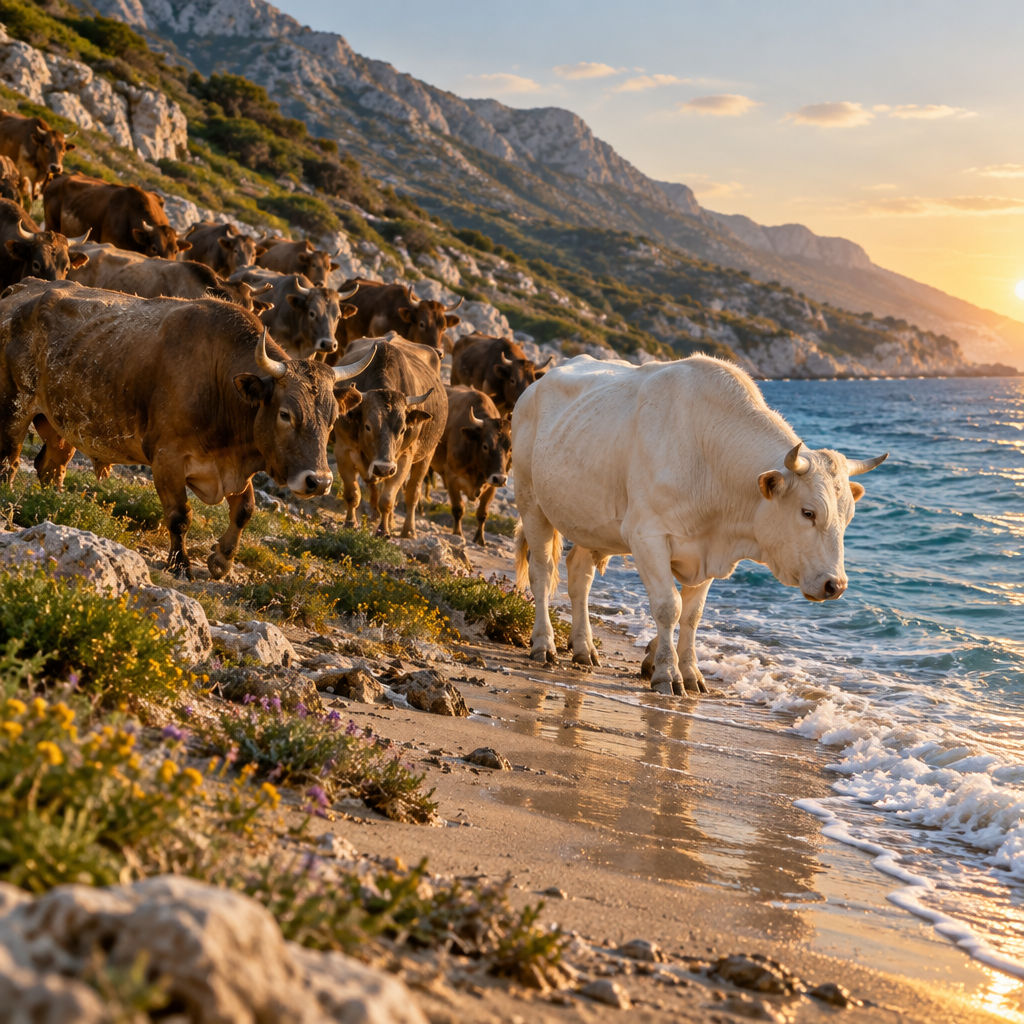
The king’s cattle came down from the mountain pastures driven by a herdsman nobody had hired. Ovid tells it from the other side: Jupiter sent Mercury to the land of Sidon to bring that royal herd down to the loud shore, where the king’s daughter liked to play with the girls of Tyre. Among the bullocks walked one more bull than the herd had owned that morning, white as unmelted snow, with small horns so fine they looked made by hand. The king was Agenor. The girl on the beach, weaving flowers for the gentle animal’s horns, was his daughter Europa, and he would never see her again.
Agenor is a figure the Greeks needed more than they described. His name is a plain Greek word, meaning something like manly or heroic, and yet every source makes him a Phoenician, lord of Tyre in some tellings and of Sidon in others. Apollodorus, the mythographer whose handbook gathers the family trees, gives him the grandest possible start. Libya bore two sons to Poseidon, Belus and Agenor. Belus stayed and ruled the Egyptians. Agenor went to Phoenicia, married a woman named Telephassa, and fathered a daughter and three sons: Europa, Cadmus, Phoenix and Cilix.
Almost every part of that list is argued over somewhere. Hyginus, writing in Latin, makes Cadmus the son of Agenor by Argiope rather than Telephassa. The oldest witness of all, the Iliad, calls Europa the daughter of Phoenix, and the poet Moschus agrees with Homer about her father while keeping Telephassa as her mother. Euripides, as an old commentator on his plays reports, gave Agenor three sons named Cilix, Phoenix and Thasus. Hyginus adds another son, Phineus, the blind Thracian prophet whose meals the Harpies stole. What every version keeps is a Phoenician king with a lost daughter and sons named for the lands they ended in.
The loss itself was quick. A daughter climbed onto a bull on the sand, the bull walked into the surf, and the surf closed behind them. Zeus carried her across the sea to Crete, and there she bore him Minos, Rhadamanthus and Sarpedon. Herodotus heard a flatter version from Persian storytellers, who stripped the gods out of it altogether: some Greeks, probably Cretans, put in at Tyre and simply carried off the king’s daughter, as payback for an earlier Phoenician kidnapping of Io. Neither account has Agenor on the beach.
What Agenor does, and it is the only thing he does in any story, is give an order. Apollodorus has him send his sons out after their sister with instructions not to come home until they had found her. Their mother Telephassa went with them, and so did Thasus, called in this telling a son of Poseidon. Ovid sharpens the command into a sentence of exile: Cadmus was to search the whole world for his sister and, if he failed, never come back. The poet’s verdict on the father is famous and exact. By one act, Agenor was both dutiful and wicked.
They did not find her. Nobody was going to outsearch Zeus. So the brothers, one by one, stopped looking and started building. Phoenix settled in Phoenicia. Cilix settled nearby, along the river Pyramus, and called the land Cilicia after himself; Herodotus records that the Cilicians had been called Hypachaei before Cilix, son of the Phoenician Agenor, gave them his name. Thasus founded a city on an island off Thrace, and Pausanias says the islanders of Thasos counted themselves Phoenicians by descent from him. Telephassa went on with Cadmus and made a home in Thrace. Cadmus, shunning his country and his father’s anger in Ovid’s words, went to Delphi instead, followed an unyoked heifer across Boeotia until she lay down in the grass, and founded Thebes on the spot. When he killed the serpent at the spring, a voice from nowhere addressed him by his father’s name: son of Agenor.
That phrase follows the whole family. Cadmus is son of Agenor in Herodotus, who says he left Phoenician settlers on the island of Thera. Europa is daughter of Agenor in Ovid and Hyginus. Virgil, centuries later, has Venus describe Dido’s new Carthage to Aeneas as the city of Agenor, a single phrase that folds the whole Tyrian royal line, and Carthage with it, back into this one ancestor. The king himself seldom speaks. He is the name at the top of the page.
That is the honest centre of him. Agenor lives almost entirely as a starting point. The Greeks had a real memory of Phoenician traders and settlers across their seas, and they told it the way they told most things, as a family story. James Frazer, translating Apollodorus in 1921, put it bluntly in his notes: all that can safely be inferred from these legends is that the Greeks traced a blood relationship between Phoenicians and Cilicians and recognised a Phoenician element in some islands and parts of the mainland. Frazer then ventured a more romantic guess of his own, that the brothers searching for a sister might be Phoenician sailors steering west toward a setting moon, but he offered it as a possibility, and it remains his.
No text describes Agenor’s body, his age, his dress or his palace. The closest the sources come is the texture of his wealth: cattle grazing high on the mountain grass above Sidon, a shore close enough to the house that the princess could wander down to it with her companions, the salt wind and the sound of the surf. Beyond that he has no face. Nor does any of the main tellings bring him back on stage after the order is given. Apollodorus and Ovid leave him in Phoenicia once the order is given and never say how he ended.
His power was a king’s power and nothing more. He could command herds, a household and grown sons, and his word carried far enough to shape the map, since Cilicia, Thasos and Thebes all traced their founders to his children. Against a god that authority was worthless. He could not keep Zeus off his beach or get his daughter back, and the very command meant to restore his family scattered it for good. The rest of his house belongs to other stories. Agenor began the tale with a daughter and a household of sons, and ends it as a name his children carried away with them.
The name also passed to others, which is worth knowing when reading the old texts. A Trojan Agenor, son of Antenor, stands against Achilles outside the walls of Troy in the Iliad and is snatched away in mist by Apollo. Apollodorus also mentions an Agenor among the sons of Niobe and another among the sons of Phegeus. They share nothing with the Phoenician king but a common Greek word.
Frequently Asked Questions
Who was Agenor in Greek mythology?
Agenor was a Phoenician king of Tyre or Sidon in Greek mythology. Apollodorus makes him a son of Poseidon and Libya and the brother of Belus, who ruled Egypt. He is best known as the father of Europa and Cadmus.
What happened when Zeus took Agenor’s daughter Europa?
When Zeus, in the form of a white bull, carried Europa across the sea to Crete, Agenor sent his sons to find her and told them not to return without her. Ovid says Cadmus was threatened with exile if he failed. None of the brothers found Europa, and they gave up the search and settled in new lands instead of returning home.
Who were Agenor’s children?
The most common list gives Agenor a daughter, Europa, and sons Cadmus, Phoenix and Cilix, with Telephassa as their mother. Other sources add Thasus and Phineus, and Hyginus names Argiope as the mother of Cadmus. Homer, by contrast, makes Europa the daughter of Phoenix rather than Agenor.
What places were named after Agenor’s sons?
Cilicia in Asia Minor was named after Cilix, and Herodotus says its people were called Hypachaei before him. The island city of Thasus was founded by Thasus, and Cadmus founded Thebes in Boeotia. Phoenix stayed in Phoenicia.
Why does Virgil call Carthage the city of Agenor?
Virgil calls Carthage the city of Agenor because Dido and her people came from Tyre, the city of Agenor’s royal line. The phrase treats the whole Tyrian royal family, and the colony it founded in Africa, as descendants of this one ancestral king.
Related Entries
Europa, Cadmus, Zeus, Poseidon, Hermes, Minos, Rhadamanthus, Sarpedon, Io, Semele, Necklace of Harmonia, Harpy, Apollo, Achilles, Melqart