
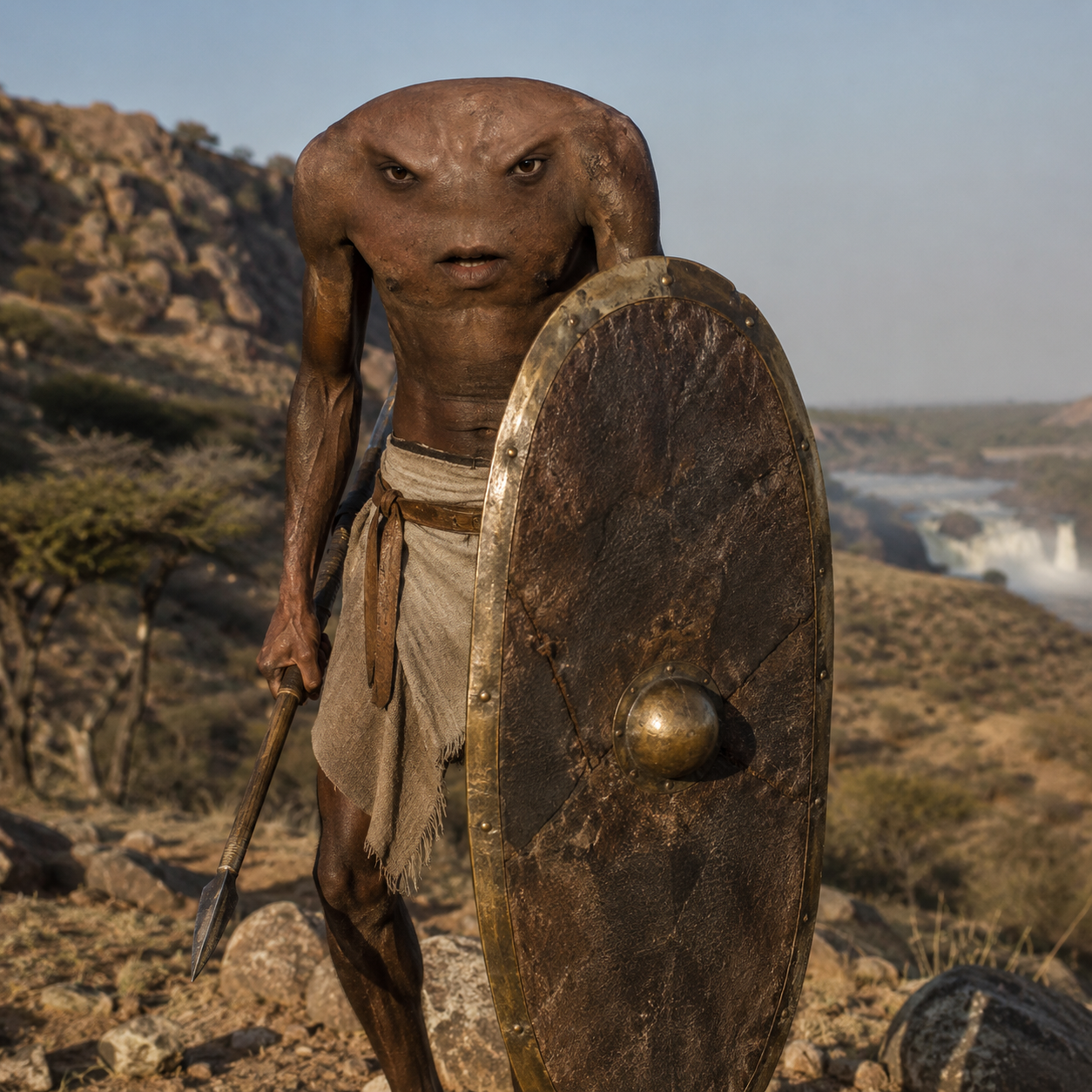
Acephali (singular: Acephalus; also Akephaloi, Blemmyae, Sternophthalmoi, “Chest-Eyes”)
Region/Culture: North Africa (placed by classical authors in Libya, Aethiopia, and the lands bordering Nubia)
Mythos: Greek Mythology, Roman Mythology, Medieval European Mythology
Primary Type/Nature: Monsters and Beasts
Mythical Attributes: Their entire anatomy is rearranged so that the face occupies the upper torso, with no neck and no head at all.
Role in Mythos: They populate the southern margins of the classical world as proof that the edges of the map hold beings stranger than any animal.
Relation to Humans: Ancient geographers placed them along trade routes and at the limits of military expeditions, where Greek and Roman observers either avoided them or fought them as a savage people. Medieval bestiaries inherited the description and offered them as evidence of a creation more various than the cathedral schools could account for, and later travel writers claimed sightings as far afield as India and the New World.
The story walked out of the desert. Caravan masters returning from the Libyan interior carried it home with the salt and the ivory, told first in tents at the edge of cultivated land, then again in the markets at Cyrene, and finally written down in Greek by a man who had never seen the place himself. The tellers swore by it. In the dry country beyond the springs and the wild olive, beyond the last of the Nasamones, there lived a people who had no heads.
Herodotus is the first to put it on a page. In his catalogue of the marvels of the eastern frontier of Libya, in among the dog-headed men and the wild beasts and the snakes, he sets down a single sentence: the Akephaloi, headless ones, who carry their eyes in their chests, as the Libyans say. He attributes it to hearsay and moves on, the way a careful man passes a story along without quite signing his name to it. The note is brief enough to fit in the palm of a hand, and it stayed alive for two thousand years.
Pliny the Elder picked it up four centuries later and gave the creatures a sharper outline. In the Natural History he calls them Blemmyae and places them in the southern reaches of Aethiopia, in the dry country near the Nile cataracts. They have no heads, he writes; their mouths and eyes are seated in their breasts. Pliny is doing what Pliny does, sorting the world’s rumors into entries, listing the Blemmyae alongside the Garamantes and the dog-headed Cynocephali as if they were one more cataloguable race. The brevity is the spell. He does not argue for them. He simply puts them on the shelf, and there they sat.
A picture forms across the sources without ever quite resolving. A grown man’s torso, the shoulders sloping into nothing where a head should be. Two eyes set into the upper chest, watching out from between the breastbones. A mouth lower down, sometimes with a nose in the line above it, sometimes not. The skin is whatever colour the climate demands. The voice, when it speaks at all in the texts, comes from somewhere around the diaphragm and carries the rough edge of a chest cold. There is no neck to break. There is no head to lop off in a duel. They walk like anyone else, hunt like anyone else, sleep with their faces turned upward at the stars.
What they were doing down there is the next question, and the answers thinned over the centuries. The earliest tellings show them simply living: tending whatever flocks the country supported, lighting cookfires at dusk, sending up smoke that any passing trader could see and choose to avoid. Strabo, who refused to believe in the headlessness, identified the Blemmyes with a real Nubian people of that name who raided the southern Egyptian border and gave the Roman garrisons trouble for generations. Pliny then folded the actual raiders into the bestiary and produced the hybrid that medieval Europe would inherit: a real African tribe with a fantastic anatomy welded onto its name.
The medieval mapmakers loved it. Headless figures appear in the margins of the Hereford mappa mundi, in the Beatus apocalypses, in the Nuremberg Chronicle, always pushed to the south or the far east, always crowded in among the other monstrous races at the world’s rim. Sir John Mandeville, that probably-fictional traveler of the fourteenth century, claimed to have seen them himself on an island somewhere off the coast of Asia, and described folk of foul stature and cursed kind with their eyes in their shoulders. Shakespeare worked them into Othello, where the Moor wins Desdemona’s pity by telling tales of the Anthropophagi and men whose heads do grow beneath their shoulders. Two centuries later Walter Raleigh reported them again, this time in Guiana, the geography stretched out around them like an elastic band that refused to snap.
Their powers are the powers of a story that will not stop being told. They were said to be tall and uncommonly strong, hardened by a country that grew nothing soft. The combat advantage is obvious if you take the anatomy at face value: no exposed throat, no easy decapitating stroke, the face protected by the cage of the ribs. Modern scholars who try to find a kernel of reality in the legend have suggested the Blemmyae’s reputation came from a Nubian fighting stance, the head dropped low and pressed to the chest behind a raised shield, which from a distance could make a man look as if he had no head at all.
The weaknesses are the weaknesses of any other person. They bleed when cut. They die when speared. Strip the marvel away and what remains is a tribe at the edge of the trade routes who fought well and were resented for it, and around whom a long civilization built a small, durable nightmare it could keep on its maps without ever having to look in the face.
Frequently Asked Questions
What are the Acephali?
The Acephali are a legendary race of headless humans described by ancient Greek and Roman writers, with their eyes, nose, and mouth set into their chest instead of on a head. The name comes from the Greek akephaloi, meaning “headless ones.” They are also called Blemmyae and were said to live at the southern edge of the known world, particularly in Libya and the Nubian borderlands of Aethiopia.
Who first wrote about the Acephali?
Herodotus is the earliest surviving source, mentioning them in his Histories around 440 BCE among the marvels of the Libyan frontier. Pliny the Elder gave a fuller account in his Natural History, calling them the Blemmyae and placing them in the lands south of Egypt. The description was repeated for nearly two thousand years afterward, surviving into medieval bestiaries, Mandeville’s Travels, and even the writings of Walter Raleigh.
Where do the Acephali live?
Classical sources place the Acephali in North Africa, somewhere in the Libyan or Aethiopian interior near the Nubian border. Medieval and early modern writers moved them further afield, putting them on islands in the Indian Ocean and, by the time of Raleigh, in the South American region of Guiana. Their location followed the receding edge of the known world wherever the cartographers needed monsters.
Is there any real basis for the headless men of myth?
Modern scholars generally think the legend grew from second-hand reports about the Blemmyes, a historical Nubian people who raided the southern Egyptian frontier in Roman times. One theory holds that the Blemmyes fought in a low crouch with the head pressed against the chest behind a raised shield, which from a distance could give the impression of a headless warrior. Greek and Roman writers, working from rumor, simplified this into a literal anatomy.
Are the Acephali the same as the Blemmyae?
In classical and medieval sources the two names refer to the same legendary race, with Acephali being the Greek-derived term for “headless ones” and Blemmyae being the name Pliny preserved from earlier accounts. Strabo distinguished the historical Blemmyes tribe of Nubia from the mythical headless race, but later writers fused the two together, and the conflation has stuck ever since.
Related Entries
Blemmyae, Cynocephalus, Panotti, Astomi, Hippopodes, Monopod, Aigamuxa, Bonnacon, Basilisk, Manticore, Phoenix