
Melusine
Also Known As: Mélusine, Melusina
Region/Culture: Western Europe
Mythos: French Mythology, Medieval Mythology, European Mythology
Primary Type/Nature: Shapeshifters
Mythical Attributes: A fairy cursed to become a serpent from the waist down every Saturday, who raises castles overnight, founds a dynasty, and departs as a winged dragon.
Role in Mythos: She is the fairy foundress and builder of the noble House of Lusignan, whose hidden serpent nature ultimately destroys her marriage.
Relation to Humans: She marries a mortal knight and makes him wealthy and powerful, bearing him ten sons on the single condition that he never look upon her on Saturdays. When he breaks the vow and denounces her in public, she is condemned to her serpent form forever and returns only as a wailing omen of death to her descendants.
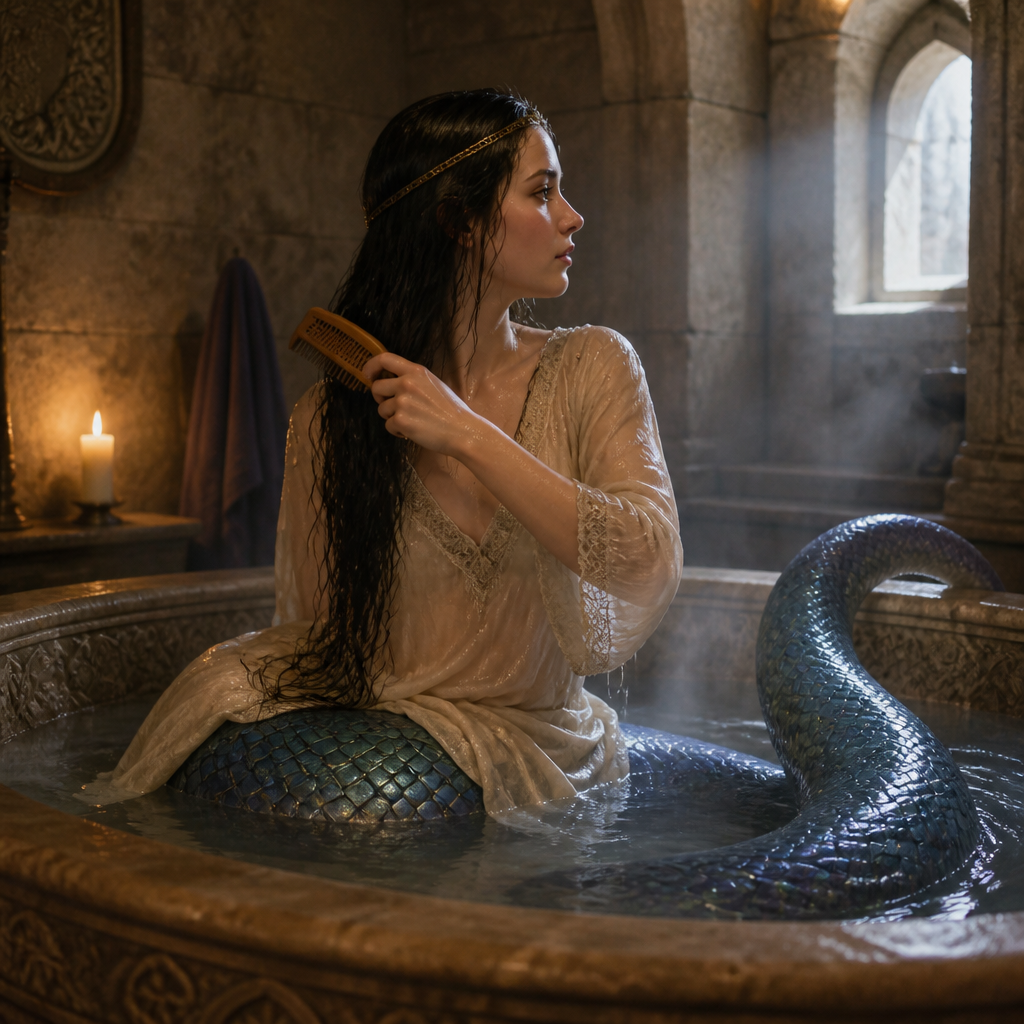
Every Saturday the door to her chamber stayed shut, and for years Raymondin let it stay that way. Then one afternoon, with a jealous brother murmuring in his ear that no honest wife hides a whole day of the week, he set the point of his sword against the wood and worked it until a small hole opened. Through it he watched his wife in her bath. From the crown of her head to the curve of her hips she was the woman he had married, combing out her wet hair in the rising steam. Below that she ended in a serpent, a coiling tail blue and silver and thick as a herring barrel, and it beat the water so hard the spray struck the ceiling. He said nothing. He stepped back, ashamed of his own eye, and let the secret stand.
For a long time that was enough. The marriage had been built, quite literally, on her keeping and his not looking.
She had not always carried the curse. In the older layer of the story her father is Elinas, king of Albany, the old name for Scotland, who met a fairy named Presine at a woodland spring and married her on a single condition: he must never come upon her while she bathed or gave birth. He swore it, and he broke it, the way men in these stories always do, bursting in on her with their newborn triplets in her arms. Presine left him and carried the three girls, Melusine, Melior, and Palatine, away to the lost island of Avalon. When the sisters were grown and learned what their father had done, Melusine led them in sealing him inside a mountain. Her mother’s punishment fell hardest on her, for being the eldest and the instigator. From the waist down, every Saturday, Melusine would take the form of a serpent, and only marriage to a man who kept faith and never watched her on that day could ever make her wholly, mortally human.
So she was waiting by a forest fountain in Poitou when Raymondin came crashing out of the dark, sick with what he had just done. He had been boar hunting with his lord and had swung wild in the confusion and killed the man by accident. Melusine already knew. She calmed him, told him how to explain the death and save himself, and offered him marriage, wealth, and a great name, asking only that he leave her to herself each Saturday and never ask why. He agreed. He would have agreed to almost anything.
What she gave him was staggering. Overnight, on land she had him beg from his neighbors, a fortress rose that no one had seen built, and she called it Lusignan after herself. She raised walls and towers and whole towns across Poitou, drained marshes, planted the country with strongholds, and turned a minor nobleman into the founder of a dynasty. She bore him ten sons. Each came into the world marked: one with mismatched eyes, one with an ear like a lion’s, one trailing a red patch across his face, and the sixth, Geoffrey, with a boar’s tusk jutting from his lip, which earned him the name Geoffrey with the Great Tooth. They did not stay home. Her sons took crowns and duchies across the known world, Cyprus and Armenia, Luxembourg and Bohemia, and the blood of a serpent fairy ran, so the tale insisted, in half the royal houses of Europe.
The ruin came from her own child. Geoffrey, wild and violent, rode against his younger brother Fromont, who had become a monk, and burned the abbey of Maillezais to the ground with Fromont and a hundred others still inside it. The smell of scorched stone reached the castle before the news did. Raymondin, wrecked by grief and rage, turned on his wife in front of the whole court and screamed that this was her doing, that she was a serpent and had bred serpents. He named the thing he had sworn never to name.
That was the end. The private glimpse she could forgive; the public word she could not survive. She confessed what she was, kissed the two youngest boys still in their cradles, and went to the window. There her body finished the change it had only ever half made on Saturdays. Wings broke from her shoulders, her lower half lengthened into the full coil of a dragon, and she threw herself into the air. She circled the tower three times, keening, a sound the old chroniclers call the most piteous ever heard, and flew off toward the horizon. She built him an empire and he called her a snake.
She never entirely left. Long after, the people of Lusignan swore that whenever a lord of the castle was about to die, or the fortress was about to pass into new hands, a wailing woman-shaped shadow would appear above the battlements, mourning aloud. The cry of Melusine became a household omen.
Her power was creation and increase. She made stone rise, made barren ground yield, made a nobody into a king’s ancestor, and she could read the shape of things to come. Her weakness was written into the same body. She was only ever safe inside a promise she did not control, and her whole fate rested on the discretion of the man she married. She could raise a fortress in a single night but could not save herself from a single spoken word. In the sixteenth century the physician Paracelsus filed her among the undines, the water spirits who have no soul of their own and can win one only by marrying a mortal and holding him. Melusine held hers for decades and lost him anyway, over a keyhole and a grief that was not even her own fault.
Frequently Asked Questions
Who is Melusine?
Melusine is a fairy from medieval European folklore, best known from the French romance written by Jean d’Arras around 1393. She is a woman cursed to turn into a serpent from the waist down every Saturday, and in the legend she becomes the fairy foundress of the noble House of Lusignan in France.
Why does Melusine turn into a serpent on Saturdays?
Melusine was cursed by her own mother, the fairy Presine, as punishment for imprisoning her father inside a mountain. The curse forces her to take a serpent’s form from the waist down every Saturday, and it can only be lifted if she marries a man who promises never to look upon her on that day.
What happens when Raymondin breaks his promise to Melusine?
Raymondin first spies on Melusine in her bath and sees her serpent tail but stays silent, so the marriage survives for years. The curse becomes permanent only later, when he publicly denounces her as a serpent in front of his court; Melusine then transforms into a winged dragon and flies away from the castle forever.
Is Melusine a mermaid or a dragon?
Melusine is usually described as a woman with a serpent’s or fish’s tail from the waist down, sometimes with two tails, which is why she is often pictured like a mermaid and used as a two-tailed heraldic figure. When her secret is finally exposed she completes the change into a winged dragon, so both images belong to her at different points in the story.
Why is Melusine important to the House of Lusignan?
Melusine was said to have built the castle of Lusignan overnight and to have founded the dynasty by bearing ten sons who became kings and dukes across Europe. Noble families including the Lusignans, the counts of Luxembourg, and even English kings claimed descent from her, using the fairy legend to lend their bloodline supernatural prestige.
Related Entries
Undine, Tarasque, Selkie, Nix, Rusalka, Mermaid, Merman, Banshee, Echidna, Lamia, Nure-onna, Siren, Sirin, Jengu, Naga