
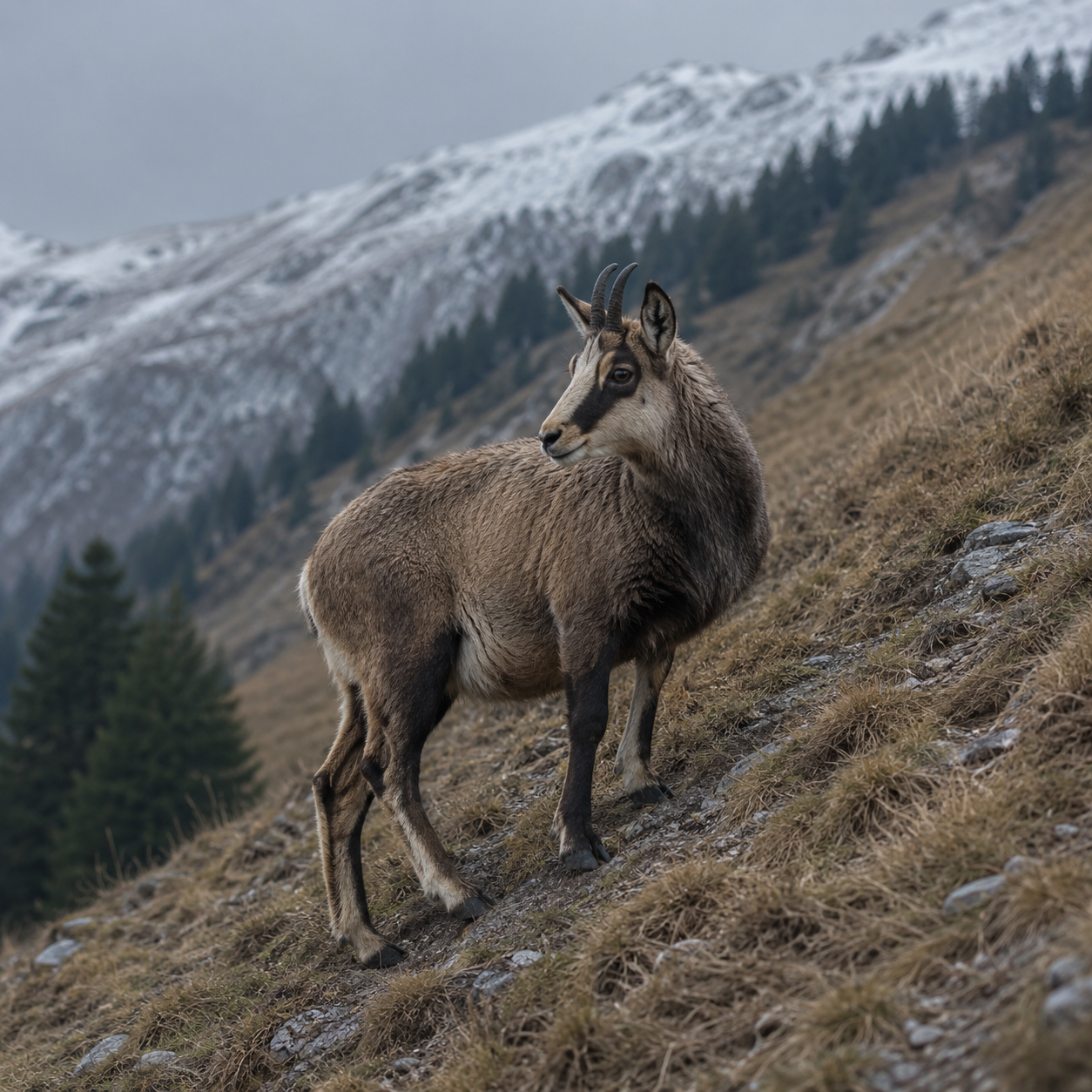
Dahu
Region/Culture: Western Europe
Mythos: French Mythology, Alpine Mythology
Primary Type/Nature: Monsters and Beasts
Mythical Attributes: A goat-like Alpine creature whose legs are shorter on one side of the body than the other, allowing it to stand and walk steadily on steep mountain slopes in a single circling direction.
Role in Mythos: The dahu sits at the centre of a long-running Alpine prank tradition, the chasse au dahu, in which locals lure a gullible visitor to a slope at night to “catch” the animal in a sack.
Relation to Humans: The dahu is functionally a social tool, used by Alpine villagers to tease tourists, newcomers, and children into a long, cold night on a mountainside. It exists almost entirely through human storytelling, and contact consists of the prank itself rather than any physical encounter.
The drop-off is steep enough that the village below is just a few yellow lights, and the city visitor has been told to crouch with the sack open between his knees and not make a sound. His guide claps him on the shoulder, says good luck, and walks back down the path. The visitor will be there for hours. Above him, somewhere in the dark fold of the mountain, there is supposed to be a goat.
That goat is the dahu. It lives in the high pastures of the French and francophone Swiss Alps, in the Jura, the Vosges, and across into the Italian Aosta Valley, and it shares its country with the chamois and the ibex it was likely modelled on. Local dialects know it by a clutch of names: dahut in the Jura, darou in the Vosges, daru in old Picardy, darhut in Burgundy, daù in Italy’s Val Camonica. The Provençal philologist Frédéric Mistral once toyed with the idea that the root went all the way back to the Sanskrit daru, meaning wood or pine. Whatever the etymology, the village knows it. The dahu walks the slopes the way most things only descend or climb. It walks across.
The trick is the legs. On one side of the body they are shorter, and on the other side longer, so that the animal stands square against a gradient that would tip an ordinary goat sideways. There are two kinds, and the village will be specific about which. A laevogyrous dahu has the short legs on its left and circles the mountain anti-clockwise. A dextrogyre dahu has them on the right and goes the other way. They do not meet, except perhaps to mate at a single point on the ridge, and they never reverse. In some villages the question of which variety lives on this particular slope has been settled for generations, and a stranger who asks the wrong way is corrected with patient pity.
The creature itself has the heavy chest and small, neat hooves of a chamois, the same dark stripe along the muzzle, the same alert, sideways ear. The horns are short and curved. The fur thickens in winter and thins in the high summer; it smells of cold grass and wet stone. Movement is steady and contour-bound, never up the slope or down it but always across, hooves placed with the patient calm of something that has never had to think about balance. No one has ever produced a body. No one will.
This is, of course, the joke. The dahu in its modern form is a tall tale, and the people who know it best are the ones who tell it. Toward the end of the nineteenth century, when the new railways began carrying wealthy city visitors up into Savoie and the Vaud to admire what they could not name, the local guides found a way to balance the ledger. The dahu hunt, la chasse au dahu, was the entertainment they invented for the tourists who arrived with too much money and too few facts. It worked best at night, on the coldest slope available, and it usually ended with the visitor crouched alone in the dark while the village walked home.
The mechanics varied. Some versions told the hunter that two people were needed: one to hold the sack, and one further up the slope to imitate the dahu’s call. The animal, hearing the call from behind, would turn its head, lose its balance on its lopsided legs, and tumble down the mountainside straight into the open bag. Other versions cut the second figure entirely and left the visitor alone with the sack and the cold. By dawn the dahu had not arrived. The visitor walked back into the village to discover that everyone had been awake for hours, already laughing.
The hunt outlived its first audience. When the gullible tourists thinned out in the mid-twentieth century, the dahu retreated upward into summer camps and scout troops, where it became the standard prank played on the newest child in the group. The form held: a bag, a slope, a long wait, and the slow understanding. In 1967, on the first of April, the prefect of Haute-Savoie made it semi-official by declaring the hills above Reignier a Dahu Sanctuary, with hunting and photography forbidden. The decree is a kindness. It protects an animal that does not need protecting.
The dahu’s powers, such as they are, follow from the lopsided body. It can stand at angles no ordinary goat can hold. It can graze along a contour line forever without descending. It vanishes between rocks the way smoke vanishes between fingers, and the only sound it leaves is the rustle of something the wind might have made. Its weaknesses are baked into the same anatomy. Turn it around and it falls. Place it on flat ground and it staggers. A dahu that cannot keep walking in its given direction does not walk at all, and this is the weakness the hunters in the story rely on, and the weakness none of them have ever tested. The dahu is uncatchable in the way that all the best uncatchable things are. It is uncatchable because it isn’t there.
Frequently Asked Questions
What is a dahu?
The dahu is a legendary goat-like creature from the French and francophone Swiss Alps whose legs on one side of its body are shorter than the legs on the other side. This asymmetry lets the dahu walk steadily along steep mountain slopes, always circling its mountain in a single direction.
Why does the dahu only walk one way around the mountain?
A dahu’s lopsided legs commit it to a single direction. A laevogyrous dahu, with shorter legs on the left, circles the mountain anti-clockwise, while a dextrogyre dahu, with shorter legs on the right, circles it clockwise. Reversing course would put the long legs on the downhill side and the dahu would lose its footing.
What is a dahu hunt?
A dahu hunt, or chasse au dahu, is a traditional Alpine prank in which a gullible newcomer is taken up the mountain at night, given a sack, and told to wait alone for a dahu to fall into it. The other hunters quietly walk back to the village while the visitor crouches in the cold until dawn.
Is the dahu real?
The dahu is a tall tale, not a real animal. The tradition is recognised as a hoax that crystallised in the late nineteenth century, when Alpine guides used it to prank wealthy tourists; no specimen has ever been produced, and folklorists treat the dahu as a piece of social custom rather than a cryptozoological candidate.
Is there really a Dahu Sanctuary?
Yes. On April 1st 1967 the prefect of Haute-Savoie officially declared the mountainous suburbs of the small town of Reignier a Dahu Sanctuary, with hunting and photography forbidden. The decree is treated locally as part of the joke and helps keep the dahu tradition alive.
Related Entries
Tatzelwurm, Barbegazi, Wolpertinger, Beast of Gévaudan, Drac, Tarasque, Farfadet, Matagot, Cheval Gauvin, Jackalope, Squonk, Hodag