
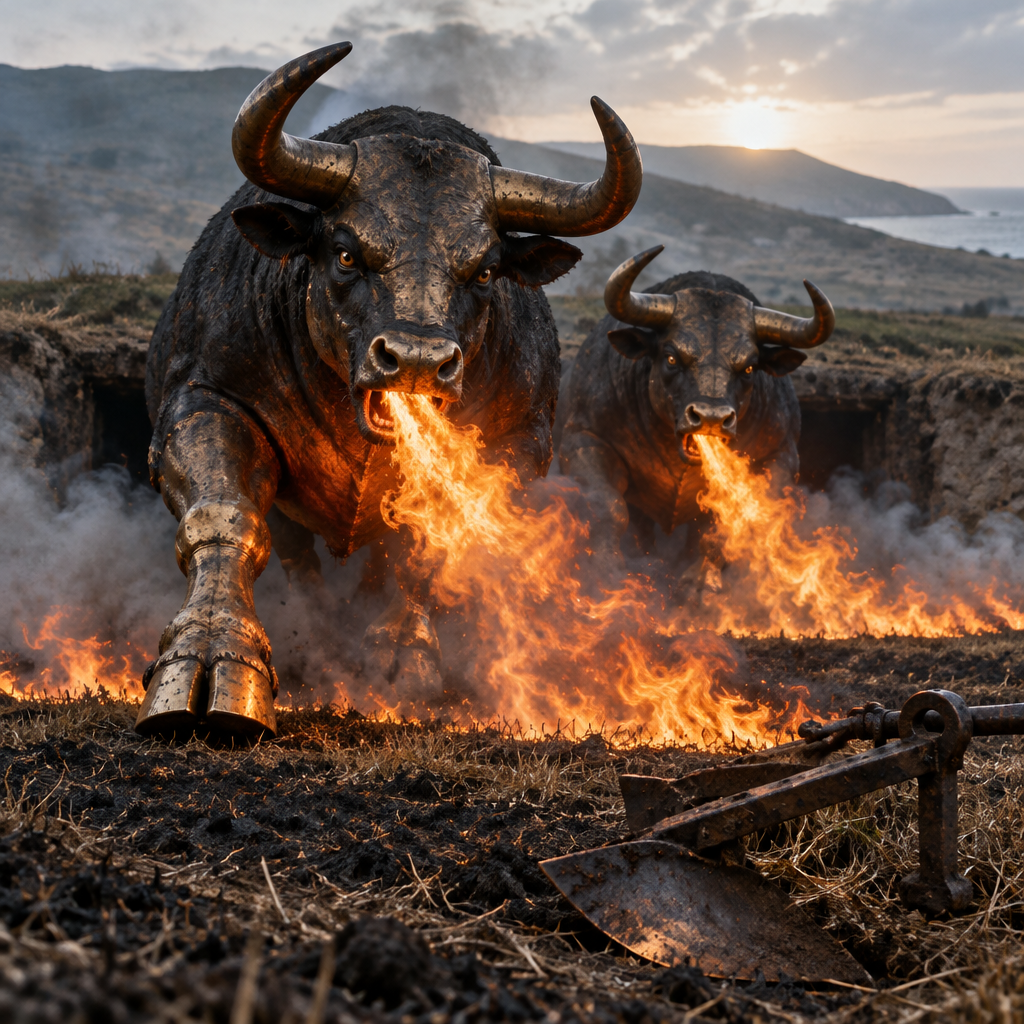
Khalkotauroi
Also Known As: Greek, “bronze bulls”; also the Colchian Bulls, the bulls of Aeetes; the ancient poets describe them as bronze-footed, fire-breathing bulls rather than giving them one fixed name
Region/Culture: Southern Europe
Mythos: Greek Mythology
Primary Type/Nature: Monsters and Beasts
Mythical Attributes: A pair of bulls forged by Hephaestus, with bronze hooves and mouths that pour out fire.
Role in Mythos: They are the first of the impossible tasks King Aeetes of Colchis sets Jason before he will give up the Golden Fleece.
Relation to Humans: Any man who tried to yoke them would be burned, which is exactly why Aeetes chose them as his test. Only Jason managed it, and only because Medea gave him an ointment that kept fire and iron off his skin for one day.
The ground on the plain of Ares is black in patches, and the grass there grows short and brittle. Somewhere under it, in a stall dug into the earth, two bulls are breathing. The air above the entrance shimmers. When they come up into the daylight, they come wrapped in their own smoke, and the noise they make is not lowing at all. It is the hollow roar of a forge.
These are the bronze bulls of Colchis, the beasts that King Aeetes kept at the far eastern end of the Greek world, on the coast of what is now Georgia. They belong to the story of the Argonauts, and they turn up wherever that story is told: in Pindar’s fourth Pythian ode in the 460s BC, at length in the third book of the Argonautica of Apollonius of Rhodes in the third century BC, in the handbook of myth credited to Apollodorus, in Ovid’s Metamorphoses and Heroides, in Seneca, and again in the Latin Argonautica of Valerius Flaccus. The poets describe rather than name them. They are bronze-footed, bronze-hoofed, fire-breathing. The single word Khalkotauroi, “bronze bulls”, is the convenient modern label for a pair that every ancient teller recognised at once.
They were a gift. Apollonius says Hephaestus made them, along with a plough of hard tempered metal, and gave them to the sun god Helios, Aeetes’ father. It was a thank-offering. During the war of the gods against the Giants at Phlegra, Hephaestus had been worn out in the fighting, and Helios lifted him into his chariot and carried him clear. The smith repaid the ride the only way a smith can, with something made. Helios passed the bulls on to his son, and Aeetes put them to work as a weapon. The Latin poets keep the same maker under his Roman name, Vulcan.
What the bulls actually look like is less clear than how they behave. Every source agrees on the feet: bronze, heavy, ringing on the earth. Pindar gives them jaws that gleam gold while they breathe fire. Nonnus, writing much later, adds a hot collar and a yoke-pole that burned to the touch. Nobody says they had bronze hides from horn to tail, and nobody says they did not. They are bulls in shape and size, as far as anyone tells it. The flame and the metal are what made them monsters.
Aeetes did not want to give up the Golden Fleece, and he did not want to be seen refusing a guest either. So when Jason arrived and asked for it, the king set terms that sounded fair and were meant to be fatal. Yoke the bulls. Plough the field of Ares with them. Sow the furrows with serpent’s teeth, the leftover teeth of the dragon Cadmus had killed at Thebes. Then kill the armed men who would grow out of the ground. All of it between dawn and dusk. In Pindar’s version Aeetes shows how it is done first, driving the team himself and cutting a furrow a fathom deep, then hands over the plough and dares the stranger to match him. It was a magnificent piece of showing off.
It would have worked, except that Aeetes’ daughter Medea had fallen for Jason. She was a priestess of Hecate and skilled with drugs, and she made him an ointment. In Apollonius it is pressed from a flower that first sprang up where blood dripped from Prometheus, chained on the Caucasus while the eagle fed on him. Rubbed into the skin, along with the shield, spear and sword, it made a man proof against fire and bronze for a single day. One day was all the contest lasted, and all the protection Jason had.
On the morning of the trial the bulls rose up out of their underground stall in a cloud of smoke and charged. Jason planted his shield and took the blast of their breath full on. Apollonius likens the noise to bellows in a foundry, roaring and then sinking and then roaring again as the fire is fed. The flame poured over Jason and did not catch. He seized one bull by the horn and dragged it down onto its knees, kicked the bronze foot out from under it, and threw the second the same way. Castor and Polydeuces ran in with the yoke, and Jason fastened it on. Then he picked up the plough and drove. In Pindar he simply drops his saffron cloak, takes hold, and finishes the measure of ground while Aeetes watches with a grief he has to keep silent.
The furrows took the dragon’s teeth, and the field sprouted soldiers. Jason threw a stone among them, and the earthborn men turned on each other. The bulls drop out of the story the moment the ploughing ends. They had done what they were made to do, and someone had done it back.
Their powers were simple and dreadful. Fire that could reduce a man to ash, the weight of bronze behind every hoof, and the strength to drag a metal plough through hard ground. Seneca’s Medea, years later and plotting murder, counts among her magical stores flames taken from the throat of the Colchian bull, as if that fire were a substance worth keeping. Their weakness was that they were cattle at heart. They could be yoked. A man who could stand in the flame could take them by the horns, and Medea’s drug let one man do exactly that.
Not every ancient writer believed in them. The historian Diodorus of Sicily, in the first century BC, reported a tidier explanation: the fleece had been guarded by men from the Tauric Chersonese, the Crimea, and since tauros is the Greek for bull, the guards called Tauroi turned into fire-breathing bulls in the retelling. It is the kind of answer that explains a monster by removing it. The poets kept the bulls.
Frequently Asked Questions
What are the Khalkotauroi?
The Khalkotauroi are the bronze-footed, fire-breathing bulls of King Aeetes of Colchis in Greek mythology. Jason had to yoke them and plough the field of Ares with them before Aeetes would give him the Golden Fleece. They appear in Pindar, Apollonius of Rhodes, Apollodorus, Ovid and other ancient writers.
Who made the bronze bulls of Colchis?
The god Hephaestus made the bronze bulls, according to Apollonius of Rhodes. He gave them, with a metal plough, to the sun god Helios as thanks for rescuing him during the war against the Giants at Phlegra. Helios gave them to his son Aeetes.
How did Jason survive the fire-breathing bulls?
Jason survived because Medea, the daughter of Aeetes, gave him a magical ointment. It protected him from fire and bronze weapons for one day. In Apollonius of Rhodes the ointment is made from a flower that grew from the blood of Prometheus.
What task did Aeetes set Jason with the Khalkotauroi?
Aeetes ordered Jason to yoke the bronze bulls, plough the field of Ares with them, and sow the furrows with dragon’s teeth, all in a single day. Armed men grew from the teeth and had to be defeated as well. Jason completed the task with Medea’s help.
Were the Khalkotauroi real?
The Khalkotauroi are mythical. The ancient historian Diodorus of Sicily suggested the story began with guards from the Crimea called Tauroi, a name that sounds like the Greek word for bulls. The poets who told the Argonaut story kept the bulls as fire-breathing monsters.
Related Entries
Jason, Medea, Argonauts, Colchian Dragon, Chrysomallus, Hephaestus, Helios, Ares, Gigantes, Cadmus, Talos, Gegenees, Cretan Bull, Minotaur