
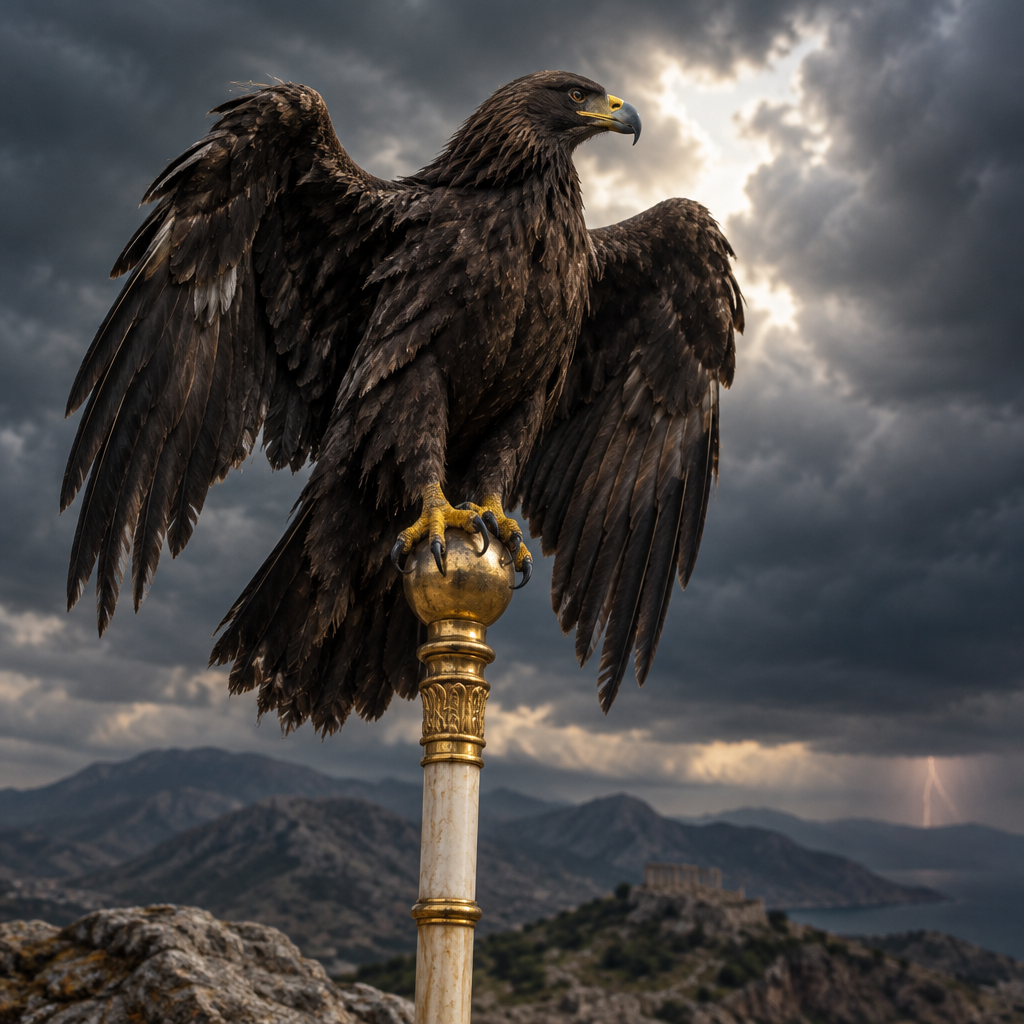
Aquila
Also Known As: Latin aquila, eagle; also Iovis ales, the bird of Jupiter, and Iovis armiger, Jupiter’s armour-bearer; Greek Aetos Dios, the eagle of Zeus; in the sky the constellation Aquila, which some Latin writers called Vultur volans, the flying vulture
Region/Culture: Southern Europe
Mythos: Roman Mythology, Greek Mythology
Primary Type/Nature: Monsters and Beasts
Mythical Attributes: The eagle of Jupiter carries the king of the gods’ thunderbolts, flies as his chosen omen and messenger, and was held to be the one bird that lightning never strikes.
Role in Mythos: Aquila is the sacred bird and servant of Jupiter and Zeus, the carrier of Ganymede to heaven, and the eagle set among the stars as the constellation that bears its name.
Relation to Humans: For Greeks and Romans an eagle on the right hand was a sign from the sky god himself, sought by kings and read by armies before they moved. Rome carried it into battle as the silver or gilded eagle of every legion, and released a living eagle from an emperor’s funeral pyre to carry his soul upward.
The most feared bird in the Greek sky spent at least one afternoon asleep. Pindar, writing an ode in 470 BC for Hieron, ruler of Syracuse, puts it on the sceptre of Zeus while the golden lyre of Apollo and the Muses is playing. The king of birds lets its swift wings sag on either side. A dark cloud has been poured over its hooked head to seal its eyelids, and as it sleeps its supple back rises and ripples, held down by the music. Everyone else in the poem is a little afraid of it. The lyre is the only thing that has ever made it stop.
Its ordinary work was noisier. The Romans called it aquila, the bird of Jupiter, and Virgil gives it a job title: Iovis armiger, Jupiter’s armour-bearer, because it carried his thunderbolts. When Ovid has Jupiter decide to take a bird’s shape, the god will accept no bird except the one that can bear his lightning. Pliny the Elder recorded the belief that no eagle is ever struck by a thunderbolt, and said that this was why it was called the armour-bearer of that weapon. The Latin handbook of star myths that goes under the name of Hyginus gives the reason Jupiter chose it in the first place: of all the tribe of birds, it alone was said to try to fly straight into the rays of the rising sun.
In Homer it arrives when a king asks for it. Old Priam, about to drive alone into the Greek camp to ransom the body of his son Hector, pours out wine and prays to Zeus for a sign: his own messenger, the swiftest of birds and the dearest to him, on the right hand. Zeus sends it at once. The dark hunter that men call the black eagle sweeps over the city on the right, its spread wings as wide as the well-bolted door of a rich man’s high-roofed storeroom, and the Trojans watching from the walls feel their hearts lift. That is what the eagle was for. It was the sky god’s signature on a decision.
Nothing in the old poems makes it more than an eagle. It is a very large one, dark, hooked and fast, but no text gives it a second head, burning feathers or a voice. Greek and Roman writers did not always keep eagles and vultures apart, and some Latin sources call its constellation Vultur volans, the flying vulture. In sculpture it was usually perched at the god’s side. Pausanias, describing the gold-and-ivory Zeus that Phidias made for Olympia, noted that the bird sitting on the top of the sceptre in the god’s left hand was the eagle.
Where it came from depends on who is telling it. Hyginus reports, from a lost history of Naxos by Aglaosthenes, that the young Jupiter was sacrificing before his war against the Titans when an eagle appeared, that he took it as a favourable omen, won, and afterwards placed the bird among the stars. The Greek collector Antoninus Liberalis tells a harsher story. Periphas, an ancient king of Attica, was so just that his people began to worship him as if he were Zeus, and built him temples. Zeus meant to burn his house to the ground with a thunderbolt, but Apollo, whom Periphas served faithfully, begged for him. So Zeus came to the house, pressed the king between his hands and turned him into an eagle, then made him king of the birds, guardian of the sacred sceptre, and the one creature allowed to approach the divine throne. His wife asked to share his fate and became another bird of good omen. Hyginus preserves a third version, in which Merops, king of Cos, lost his wife to the arrows of Diana and wanted to die of grief, until Juno pitied him, changed him into an eagle and set him in the sky.
The best known story is a kidnapping. Ganymede was a Trojan prince, the most beautiful of mortals, and Zeus wanted him. The Library of Apollodorus says flatly that Zeus carried him off by means of an eagle and made him cupbearer to the gods. Ovid has Jupiter become the eagle himself, beating the air on borrowed wings. Virgil shows the moment woven into the border of a prize cloak in the Aeneid: the boy running down stags on wooded Ida, javelin in hand, and then Jupiter’s armour-bearer dropping out of the sky and lifting him high in hooked talons. His old guardians stretch their hands to the stars for nothing. Below them the hounds bark savagely at the empty air.
The sky kept the bird. The Greek astronomers Eudoxus and Aratus already knew the constellation of the Eagle, and Ptolemy listed it among his forty-eight. The star myths say it is the eagle that carried Ganymede, placed there to mark the service, or the omen of the Titan war, or Merops. Hyginus adds a lighter story in which Mercury fell in love with Venus and was refused, until Jupiter sent the eagle to snatch one of her slippers while she bathed in the river Achelous and carry it to Mercury in Egypt. Venus came after her shoe, and Mercury got what he wanted. In gratitude, the story goes, he put the eagle in the sky. The shape itself may be older than any of these tales: modern historians of astronomy think the Greek Eagle probably descends from a Babylonian constellation of the same bird. Its brightest star, Altair, has an Arabic name meaning the flying eagle.
This is not the eagle that tore at Prometheus. Apollodorus says Zeus set an eagle on the chained Titan to eat his liver, but he calls that bird a child of Typhon and Echidna, a monster in its own right, and it is Heracles who finally shoots it down.
Rome made the bird into metal. Pliny writes that the eagle was once only the first of five legionary standards, alongside the wolf, the Minotaur, the horse and the boar, and that Gaius Marius, in his second consulship, gave it to the legions alone. After that every legion marched behind its own eagle, and to lose it was a disgrace that could take decades to repair. Tacitus records that in AD 16, before a battle in Germany, Germanicus saw eight eagles flying toward the enemy’s forest and told his army to follow the Roman birds, the legions’ own gods. The bird’s last duty was to the dead. At the funeral of Augustus, Cassius Dio says, an eagle was released from the burning pyre and seemed to carry his spirit up to heaven, and Herodian describes the same flight at later imperial funerals.
Its power was always on loan. The eagle carried lightning because lightning could not hurt it, it read the future because the god who sent it had already made up his mind, and it could lift a prince off a mountainside because the king of the gods wanted him lifted. What it could not do was act for itself. In every version of its origin it is a servant, whether a bird Jupiter chose, a king humbled into feathers for being worshipped too well, or a widower turned into a star so that he would stop grieving. Pindar found its one real weakness: play the right music and even the armour-bearer of Zeus will close its eyes on the sceptre and sleep.
Frequently Asked Questions
What is Aquila in Roman and Greek mythology?
Aquila is the eagle of Jupiter, called the eagle of Zeus by the Greeks. It carries the god’s thunderbolts, appears as his omen and messenger, and is the eagle that carried the Trojan prince Ganymede to Olympus. It was also placed among the stars as the constellation Aquila.
Why is the eagle the bird of Jupiter and Zeus?
Ancient writers gave several reasons. Pseudo-Hyginus says Jupiter chose the eagle because it alone was believed to fly straight into the rays of the rising sun, and Pliny the Elder recorded the belief that eagles are never struck by lightning. Another tradition says an eagle appeared as a good omen before Jupiter’s war with the Titans.
Did Zeus turn into an eagle to take Ganymede?
The sources disagree. The Library of Apollodorus says Zeus carried Ganymede off by means of an eagle, while Ovid’s Metamorphoses says Jupiter turned himself into the eagle. Virgil’s Aeneid describes Jupiter’s armour-bearer seizing the boy from Mount Ida in its hooked talons.
Who was turned into the eagle of Zeus?
Antoninus Liberalis says the eagle was once Periphas, a just king of Attica whom Zeus turned into a bird after his people worshipped him like a god. Pseudo-Hyginus records another version in which Merops, king of Cos, was changed into an eagle by Juno after he wished to die of grief for his wife.
Is Aquila the eagle that ate Prometheus’s liver?
No. The Library of Apollodorus calls the eagle that tormented Prometheus an offspring of Typhon and Echidna, and says Heracles killed it. The eagle of Zeus that carried the thunderbolts and Ganymede is a separate bird in the ancient sources.
Related Entries
Jupiter, Zeus, Ganymede, Juno, Hera, Apollo, Mercury, Hermes, Venus, Achelous, Diana, Priam, Titan, Prometheus, Typhon, Echidna, Reichsadler, Anzû, Garuda, Hraesvelg, Vedrfolnir, Thunderbird