
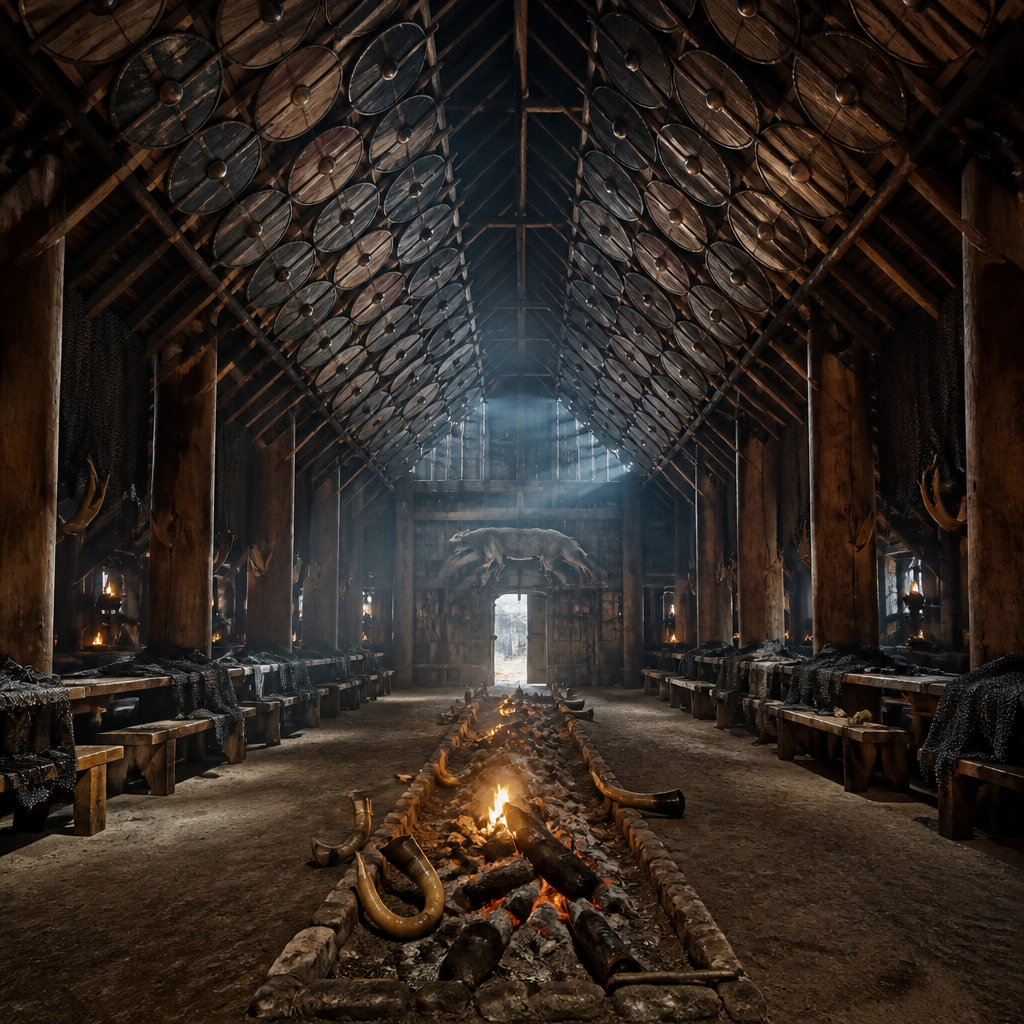
Valhalla
Also Known As: Old Norse Valhǫll, the hall of the slain; the fifth of Odin’s dwellings, standing in Glaðsheimr
Region/Culture: Northern Europe
Mythos: Norse Mythology
Primary Type/Nature: Mythological Places
Mythical Attributes: It holds an army that cannot be exhausted, fed from a beast that cannot be finished and watered from a goat that cannot run dry.
Role in Mythos: It is where Odin gathers half the men killed in battle, to be kept fed and fighting until the last war.
Relation to Humans: A man cannot buy or earn his way in by any means except being killed with a weapon in his hand, and even then the choosing is done for him. Those who arrive are not rewarded so much as retained, because the hall exists to have them ready on a specific morning.
Anyone standing in front of it works out what it is immediately, and the poem that describes it says so twice, as though the fact were the point. The roof is shields. The rafters overhead are spear shafts. Mail-coats have been thrown down along the benches and left there. Over the western door hangs a wolf, and above the wolf an eagle waits with its wings out. Nobody needs to be told whose house this is.
Valhalla is Odin’s hall, the fifth of his dwellings, gold-bright and enormous, and it stands in a place whose name means the joyful home. Every day he sits there and chooses among the men who have fallen in fighting. Half of the slain go to Freyja and her field. The other half come here, and the word for them is the einherjar, which means something close to the ones who fight alone or the sole champions, and they arrive already dead.
The scale is stated with unusual precision for a mythology that is normally vague about numbers. Five hundred doors and forty more, in the walls of Valhalla, and eight hundred fighters will go out through any one of them when the time comes to march against the wolf. The arithmetic gives an army of four hundred and thirty-two thousand, which is very obviously not a headcount but a way of saying that the hall has been filling for a long time and will keep filling.
Getting through the door is a matter of a gate called Valgrind, the death-gate, standing in front of the holy doors. It is old and it is locked, and the poem notes that very few can explain how the lock works. Before that there is a river to cross. It roars, and there is something living in it, and the host of the slain find the wading hard.
The domestic arrangements are worked out in the sort of detail that suggests somebody enjoyed thinking about them. The cook is called Andhrímnir. The pot is called Eldhrímnir. The animal is called Sæhrímnir, and every day it is boiled and eaten and every evening it is whole again, which the poem describes as the best food there is, adding that few men know what the warriors actually live on. Odin himself eats none of it. He gives his portion to the two wolves at his side, Geri and Freki, and lives on wine alone.
The drink comes from a goat. Heiðrún stands on the hall and browses the branches of the tree called Læraðr, and from her udder runs clear mead into a vat that never empties. On the same roof stands a hart called Eikþyrnir, chewing the same branches, and from his antlers water drips down into the well at the root of the world, and from that well every river on earth runs out. The bar and the water table of the cosmos are the same animal shed.
What the einherjar do all day is fight. They arm and go out and cut each other apart in the yard, and the wounds close, and in the evening they ride back in and sit down together and drink. It is a training exercise that runs for the length of the world, and the men doing it are the only ones who never get bored of it, because they were selected for exactly that.
None of this is a reward. It is a mobilisation.
The whole hall is a barracks kept at readiness for one morning, when a wolf gets loose and Odin goes out to meet him and does not come back, and every one of those doors empties at once. The poem is explicit that the five hundred and forty doors matter because of what will come out of them. Odin has spent the entire age of the world collecting the best killers on earth for a battle he already knows the outcome of, having asked. That is the strangest thing about the place and the sources do not soften it.
There is another way of counting the dead, which the sources also keep. The men who die of illness or age go to Hel, under the third root, and the men who drown belong to the sea. Nothing in the record says Valhalla is better, only that it is different, and the tests for entry are about how a man stopped rather than how he lived.
What the hall grants is straightforward. It repairs its inhabitants nightly, feeds them out of a self-restoring animal, keeps them drunk on a goat, and holds them at a standard of fitness no living army could sustain. It confers a kind of permanence that no other Norse afterlife offers.
Its weaknesses are stranger. It cannot admit anyone on merit, because the choosing is done by Odin and his valkyries and not by the dead man. It cannot keep anyone past Ragnarök, since the whole point of holding them is to spend them. And its walls, being made of spears and shields, are the same material as the problem they are stored against. The hall of the slain is a beautiful building put up by someone who is going to lose.
Frequently Asked Questions
What is Valhalla in Norse mythology?
Valhalla, Old Norse Valhǫll or hall of the slain, is Odin’s great hall, where he gathers half of the men who die in battle. Its rafters are spears and its roof is made of shields, with a wolf hanging over the western door and an eagle above it. The dead who live there are called the einherjar.
How do you get into Valhalla?
Only by being killed in battle, and even then the choice is not the dead man’s. Odin sits in the hall each day and chooses among the fallen, and the valkyries bring his share to him. The other half of the battle-dead go to Freyja, while those who die of sickness or old age go to Hel.
What do the warriors in Valhalla eat and drink?
They eat the boar Sæhrímnir, which the cook Andhrímnir boils each day in the cauldron Eldhrímnir and which is whole again by evening. They drink mead from the goat Heiðrún, who stands on the hall browsing the branches of a tree and fills the vat from her udder. Odin eats nothing and lives on wine, giving his food to his wolves Geri and Freki.
How many doors does Valhalla have?
Five hundred and forty, according to the poem Grímnismál, and eight hundred fighters go out through each one when they march against the wolf at Ragnarök. The figures are usually read as a way of describing an inexhaustible army rather than as an actual count.
Why does Odin collect dead warriors at all?
Because he is preparing for Ragnarök. The einherjar fight each other every day, recover from every wound, and feast every night, which keeps them at fighting readiness indefinitely. When the last battle comes they pour out of Valhalla’s doors at Odin’s side, and the sources are clear that he already knows he will die there.
Related Entries
Odin, Einherjar, Valkyrie, Eikthyrnir, Ragnarök, Fenrir, Hel, Yggdrasil, Æsir, Freyja, Thor, Huginn and Muninn, Mímir, Jötunn, Draugr