
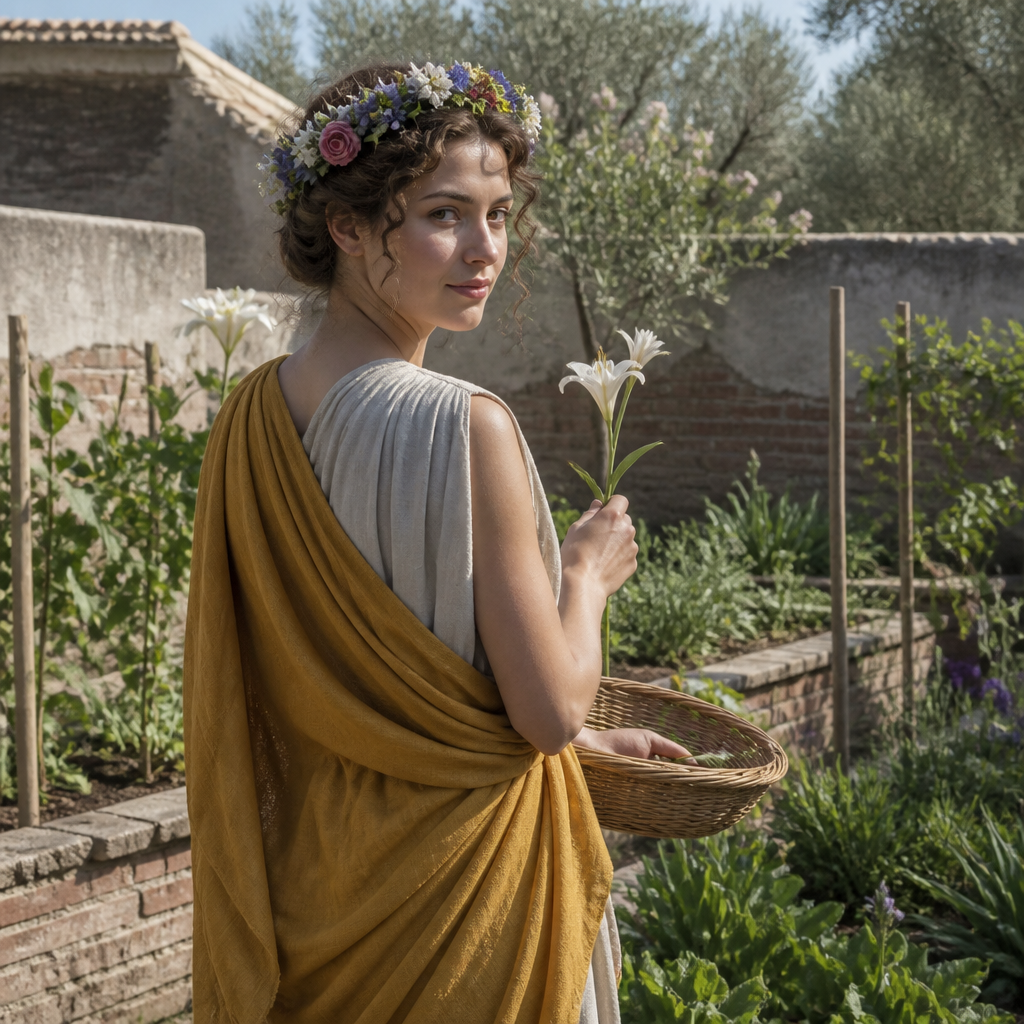
Flora
Also Known As: Latin *flos, floris*, “flower”; identified by Ovid with the Greek nymph Chloris, Χλωρίς, “green shoot”
Region/Culture: Southern Europe
Mythos: Roman Mythology
Primary Type/Nature: Gods and Deities
Mythical Attributes: She holds jurisdiction over the flowering itself, the blossom on grain, vine, olive and bean, and over the honey that begins in it.
Role in Mythos: She is the state goddess whose favour decides whether a year’s crops set fruit at all, and whose festival licensed a week of coloured clothes, lamplight and open indecency at the foot of the Aventine.
Relation to Humans: Rome kept a full-time priest for her and a fixed date in the public calendar, and turned to her by name when the blossom failed. She was claimed particularly by the plebs and by the prostitutes of the city, who treated her games as their own.
Every other festival in the Roman year had a dress code, and the code was white. For six days at the turn of April and May the crowd below the Aventine wore whatever colours it happened to own, the shows carried on after dark by lamplight, and the Circus Maximus was stocked not with lions but with roe deer and hares, which broke and scattered across the sand while chickpeas and vetch came down out of the stands onto the heads of the people. The goddess all this was for had a priest older than the Republic and almost no story at all.
Flora governed the flowering. Not the harvest, not the fruit, not the plant, but the blossom: the short window of colour on which everything afterwards depended. Ovid lets her explain it herself, and the speech reads like a farmer’s ledger. If the crops flower well the threshing floor churns wealth. If the vines flower well, the wine flows. If the olives flower well, the year shimmers and fills with fruit. Damage the bloom and the vetches and the beans are finished, and so are the lentils out of Egypt. Honey belongs to her too, because honey starts in blossom, and she says she calls the bees to the violets, the clover, and the thyme that has gone grey at the tips.
That kind of narrow, technical jurisdiction is the signature of the oldest layer of Roman religion, where a god is a job. Varro, working through the Latin language, cites the Annals for a list of altars vowed by Titus Tatius, the Sabine king who ruled alongside Romulus: Ops, Flora, Vediovis and Saturn, Sun and Moon, Vulcan and Summanus, then Larunda, Terminus, Quirinus, Vertumnus, the Lares, Diana and Lucina. Flora sits there in the second position, among the imports Rome absorbed before it had a history worth the name. She also had her own flamen, and that is the detail that settles the question of her age. There were twelve of these minor priests, each attached to a single deity, and only ten of the names survive. One of the ten is the flamen Floralis. The Roman state employed a man whose whole function was the blossoming.
The temple came much later and came out of a disaster. The dates in the sources do not agree: Velleius Paterculus points to 241 or 240 BC, Pliny to 238, and the Sibylline books were consulted because the crops had failed to set. The building was funded out of fines levied on men who had been quietly grazing their herds on public pasture, a scam that had gone unprosecuted for years until the plebeian aediles Lucius and Marcus Publicius took it to court. Flora got a share of the money and her first games; the rest paid for cutting a road up the sheer face of the Aventine, which was still called the Clivus Publicius when Ovid wrote about it three centuries later. The temple itself has never been found, but the calendar carved at Allifae files it plainly as Flora’s, by the Circus Maximus, and Tacitus puts it on the same site as the temple of Ceres. By Augustus’s day it was falling down. He began the restoration and did not live to finish it; the rededication waited until the early years of Tiberius.
In her own garden it is always spring. The trees are permanently in leaf, the soil never stops feeding, and the fountains run clear. Zephyrus, who owns the place, filled it with well-bred flowers and told her the flowers were hers to rule. When the frost lifts off the leaves and the sun warms the blossom, the Horae arrive, hitch up their coloured dresses and gather the day’s crop into light tubs, and then the Graces come bursting in behind them to weave the chaplets that go on the heads of gods.
All of which Ovid appears to have invented, and the article he built it on will not bear weight. The goddess tells him she used to be Chloris, a nymph of the fields of the blessed, and that Latin speech corrupted a Greek letter of her name. It did not. *Flora* is a Latin word from a Latin root and *Chloris* is a Greek word from a Greek one, and no sound change turns either into the other. What actually happened is that a first-century poet took a functional Roman goddess who had a priest, an altar, a temple and a fixed date but no biography, and gave her one by borrowing a Greek nymph who is barely attested anywhere except in the passage doing the borrowing. The story he supplied is not gentle. Zephyrus saw her wandering in spring and chased her; he was the stronger, and she says his brother Boreas had already established the precedent by carrying Oreithyia out of the house of Erechtheus. Then he married her, which in Ovid’s telling closes the account. She says she has no complaints about the marriage.
Her one real intervention in the affairs of the gods also comes from that passage, and it is a good one. Juno turned up at the garden door, worn out from the road, on her way to complain to Oceanus that Jupiter had produced Minerva without needing a wife at all, and that she intended to try every drug on earth until she could do the same. Flora knew the answer and was frightened to give it, because Jupiter would find out. Three times she started to speak and stopped. Juno swore by the Styx that the source would stay hidden, and Flora named a flower from the fields of Olenus that grew nowhere but in her own beds, a thing that made a barren cow calve if it so much as touched her. She picked it with her thumb and put it against Juno, who conceived on the spot, went to Thrace, and bore Mars. Mars, when he heard how it had been managed, told her she ought to have a place in Romulus’ city too.
The games were not annual to begin with. They lapsed, and the year that wind, hail and rain wrecked the blossom across Italy, the Senate vowed to hold them every year if the season flowered properly. Ovid has Flora say outright why it had happened: she had been passed over, so she stopped guarding the fields and let the dowry rot, and Zephyrus kept telling her not to ruin it, and she let it rot anyway. The consuls Postumius and Popillius Laenas discharged the shows in 173 BC and the Floralia became a fixture, running from 28 April to 3 May. They were mimes and farces, and they had a reputation. The prostitutes of Rome counted the festival theirs and stripped on the stage when the audience called for it. Cato the Younger, sitting in the theatre and unwilling either to watch or to spoil the day, got up and walked out; the crowd applauded him for going, and then went back in and carried on. Martial, telling readers not to bring Cato’s face to his book, thought a man who knew what the Floralia was and turned up anyway had no business being shocked. Three hundred years after that, Lactantius explained the whole institution by claiming Flora had been a prostitute who grew rich, left her money to the Roman people to fund games on her birthday, and was retrospectively promoted to goddess of flowers by an embarrassed Senate. He had it backwards. The priesthood is older than the games by centuries.
Her powers all run through the same channel and stop at the same place. She can make a year, or lose one, at the single moment of blossom, and everything downstream of that moment belongs to somebody else; the ripened ear, the pressed oil, the vintage in the jar are not hers. She works by attention and by withdrawal rather than by force, which makes her dangerous in an oddly passive way: the ruined olives and the hailed-out vines were not something she did, they were something she declined to prevent. Her writ also has a hard geographical edge. Asked why deer and hares were netted for her in the Circus instead of Libyan lions, she answered that her ground was gardens and fields, which no savage beast enters. The wilderness is not hers, and neither are the woods.
For a goddess with no myth she had a very recognisable face. A denarius struck by C. Servilius in 53 BC carries her head wreathed in flowers alongside the boast that his family gave the Floralia first; another, struck by C. Clodius Vestalis in 41 BC, sets a lily behind her wreath. Botticelli’s *Primavera* eventually did the rest, painting Ovid’s transformation scene with Zephyrus reaching for Chloris on the right and Flora already walking away from her, and that is the image most people now carry. The name has outlasted all of it, since *flora* is still the ordinary scientific word for the plant life of a place. The driest and best summary is the one Rome cut into stone. Against 28 April in the calendar from Praeneste stands a single administrative line: on this day the temple of her who presides over things flowering was dedicated, on account of the failure of the crops.
Frequently Asked Questions
Who is Flora in Roman mythology?
Flora is the Roman goddess of the flowering of plants, responsible specifically for blossom rather than harvest. She was one of Rome’s oldest deities, with her own dedicated priest, the flamen Floralis, and an altar traditionally attributed to the Sabine king Titus Tatius. Her temple stood beside the Circus Maximus on the slope of the Aventine.
What was the Floralia?
The Floralia was Flora’s festival, held annually from 28 April to 3 May with games in the Circus Maximus and shows in the theatres. Spectators wore multi-coloured clothing instead of the customary white, deer and hares were released in the arena, and beans and chickpeas were thrown to the crowd. The theatrical performances were famously indecent, and Rome’s prostitutes regarded the festival as their own.
Why is Flora called Chloris?
Because Ovid says so in Book 5 of the *Fasti*, where Flora tells him she was once the Greek nymph Chloris and that Latin corrupted a letter of her name. The etymology is false, since Flora and Chloris come from unrelated Latin and Greek roots. The identification is a literary graft that gave a Roman goddess with no narrative tradition a Greek origin story.
How did Flora help Juno give birth to Mars?
Juno wanted a child without Jupiter’s involvement, after he produced Minerva alone. Flora told her about a flower from the fields of Olenus that grew only in her garden and could make a barren cow conceive, then plucked it and touched Juno with it. Juno conceived immediately and later bore Mars in Thrace.
Was Flora really a prostitute?
No. The claim comes from the Christian writer Lactantius, who argued around AD 310 that Flora was a wealthy courtesan whose bequest funded games on her birthday, with the Senate inventing a flower goddess to disguise the fact. The evidence runs the other way: Flora’s priesthood and her place in the state calendar are centuries older than the games, and the story is best read as polemic against a festival Christian writers found obscene.
Related Entries
Zephyrus, Vesta, Janus, Saturn, Quirinus, Lares, Di Penates, Anna Perenna, Faunus, Priapus, Cybele, Romulus, Charites (Graces), Demeter, Persephone