
Ceres
Also Known As: Latin *Cerēs*, from Proto-Italic *\*kerēs*, PIE *\*ḱerh₃-*, “to feed, to nourish”; Oscan *kerríio-* forms on the Agnone bronze; Umbrian *śerfe*; the masculine *Cerus manus* of the Salian hymn is a modern restoration of a corrupt text
Region/Culture: Southern Europe
Mythos: Roman Mythology
Primary Type/Nature: Gods and Deities
Mythical Attributes: She governs the growth and the storing of grain, and by extension the boundary rites that admit the dead, the newly married and the newly enfranchised.
Role in Mythos: She is the goddess of the plebeian half of Rome, whose temple held the plebs’ magistrates, their records and the property of anyone who laid hands on a tribune.
Relation to Humans: Romans approached her through work rather than story, offering a sow before the reaping and a measured sample of grain before the harvest was touched. Her women’s rites were run by priestesses imported from the Greek cities of the south and made Roman citizens by act of the assembly so that they could pray as citizens on citizens’ behalf.
On the nineteenth of April the crowd in the Circus Maximus watched foxes released onto the sand with burning brands tied to their backs. Ovid asked why, went looking for an answer, and came back with a farm anecdote from Carseoli in the Abruzzi about a boy who caught a hen-thieving vixen, wrapped it in straw and set it alight, and watched it run into the standing corn and burn the crop. The species has been punished at the Cerialia ever since. Ovid is the only writer who describes the rite at all, and his explanation has the unmistakable shape of a story assembled after the fact to cover something nobody could remember the reason for. The foxes ran. That much is certain.
Almost everything else about Ceres runs the same way. She is old, she is specific, and the myth everyone knows about her was fitted on at the end.
Her name goes back to a root meaning to feed, and it turns up across Italy before Rome had anything worth calling a religion. A Faliscan inscription of around 600 BC asks her for spelt. An Oscan bronze from the mountains near Agnone regulates a sacred garden belonging to Kerres and lists seventeen deities attached to it, most of them carrying her name as an adjective. Umbrian has the same word. The Romans themselves guessed she was named from *gerere*, the bearing of crops, which is a good guess and wrong.
What she actually was is easiest to see in the prayer the flamen Cerialis said. Servius preserves the list, on the authority of a Fabius Pictor: twelve gods invoked alongside Ceres and Tellus, one for every operation of the grain year in order. Vervactor for breaking the fallow. Reparator for the second ploughing. Imporcitor for the ridging, Insitor for the sowing, Obarator for ploughing the seed under, Occator for the harrowing, Sarritor for the hoeing, Subruncinator for the weeding, Messor for the reaping, Convector for the carting, Conditor for the storing, Promitor for taking it back out of store. There is no equivalent anywhere in Greek religion. It is not mythology at all. It is a job description, said aloud, twelve times, in the right order, and it tells you more about how Romans thought about the divine than any story could.
The temple is the other half of her. In 496 BC, with the city short of grain, the dictator Aulus Postumius had the Sibylline Books consulted and vowed a temple to three gods the oracle named in Greek. Three years later Spurius Cassius dedicated it at the foot of the Aventine, directly above the starting gates of the Circus, to Ceres, Liber and Libera. Vitruvius, who disliked the type, calls it wide-spaced and heavy-roofed in the Tuscan manner, with terracotta ornaments on the pediment. Two Greek artists, Damophilus and Gorgasus, modelled and painted it, split the work down the middle and signed their halves in Greek verse on the building. Inside stood what Pliny says was the first bronze image of a god ever set up at Rome, paid for out of the confiscated estate of Spurius Cassius himself, who was killed a few years later on a charge of aiming at kingship.
That temple became the headquarters of the other Rome. The plebeian aediles took their name from it and worked out of it. From 449 BC the decrees of the Senate were deposited there in copy, because at the consuls’ discretion the originals had a way of being suppressed or altered. When the plebs swore their sacred law, the sanction they chose was that anyone who struck or killed a tribune should be accursed and his goods forfeit to Ceres, so the proceeds of assaulting a plebeian magistrate physically paid for the plebeian goddess’s upkeep. Caesar later split off two aediles specifically for the grain supply and called them Ceriales, and a moneyer of 56 BC struck a denarius advertising that his own ancestor had staged her games first.
She also stood at every threshold Romans found difficult. A sow was killed in the presence of the corpse before a funeral could proceed and the heir take up the inheritance. A pit somewhere in the city, the *mundus*, was called hers, and on three days of the year it was opened, the dead were held to be abroad, and public business stopped. Virgil calls her *legifera*, the lawgiver, the first Latin rendering of a Greek cult title, and puts her at the head of the gods invoked at Dido’s disastrous marriage. Grain, graves and weddings look like an odd portfolio until you notice they are all moments when something crosses over.
The Greek layer can be dated, and it arrived in pieces. The oracle of 496 named Greek gods, so the Aventine cult was Greek-inflected from the start, and its decoration was Greek work by Greek hands. Somewhere in the third century a women’s festival came north from Velia and Naples, nine days of fasting and abstinence performed in Greek rite by priestesses who were made citizens by name so their prayers would count; Livy mentions it only because it had to be cancelled in the mourning after Cannae. In 191 BC a fast on the fourth of October was added on Sibylline advice. And then, under Augustus, Ovid wrote out the whole story of the stolen daughter, the torches, the wandering and the pomegranate, and offered it as the explanation for why Roman women wore white in April. Five centuries of foxes and sows and ploughing-gods, and the reason finally supplied for them was a poem.
Her powers are the powers of the thing itself. She makes the seed set or fail; the *praemetium*, a sample of the crop measured out and tasted before anyone else touched the harvest, was an acknowledgement that the year was hers to release. She holds the sanction behind an oath of the plebs. She purifies a house that has a body in it. Her limits are the limits of a functional deity: she has no will to speak of and no enemies, she is invoked by farmers and magistrates in fixed words rather than petitioned in a crisis, and the only time she is recorded as withholding anything is when the grain runs out, which is a description of a famine rather than a decision. The one occasion Rome felt her absence as a personal insult was the year the mourning was too heavy for her festival to be held at all.
Frequently Asked Questions
Who was Ceres in Roman mythology?
Ceres was the Roman goddess of grain, its growth and its storage, and of the boundary rites surrounding death, marriage and inheritance. Her Aventine temple, dedicated in 493 BC, served as the political and archival centre of the plebeians. Her name comes from an old Italic root meaning to feed or nourish, and she is attested in Oscan, Umbrian and Faliscan before Rome adopted Greek myth.
Is Ceres the same as Demeter?
They were formally identified, but they are not the same figure. Ceres has a deep Italic cult with no mother-and-daughter story of its own, centred on the agricultural year, the plebeian order and funeral purification. The Demeter myth of the stolen daughter reached her through Greek priestesses in the third century BC and above all through Ovid’s poetry under Augustus, who used it to explain a Roman April festival that was already old.
What was the Cerialia?
The Cerialia was Ceres’ festival on 19 April, written in large letters in Rome’s oldest surviving calendars and preceded by a week of games from 12 April. Worshippers wore white. The best-known rite was the release of foxes with burning torches tied to them in the Circus Maximus, described only by Ovid, who admitted he had to go looking for an explanation.
Why was Ceres important to the Roman plebeians?
Her temple on the Aventine was the working headquarters of the plebeian aediles, who took their title from it, and from 449 BC it housed copies of Senate decrees so the consuls could not tamper with them. Under the plebs’ sacred law, the property of anyone who assaulted a tribune was forfeit to Ceres. Caesar later created two aediles named Ceriales to handle the grain supply.
What are Ceres’ symbols?
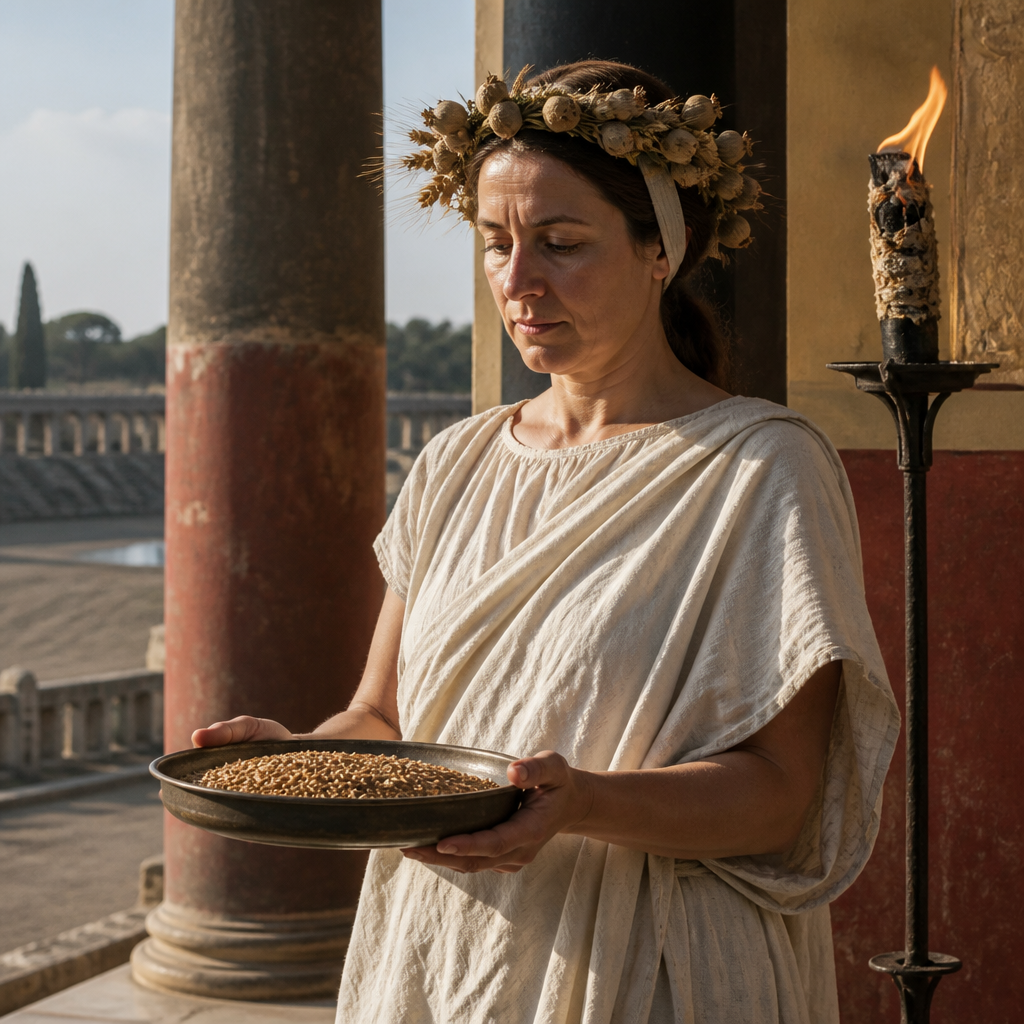
Ceres is shown crowned with wheat and barley ears, usually with poppy capsules worked into the wreath, and carrying one or two torches. A serpent often appears at her feet or drawing her chariot, and she is sometimes veiled. Her sacrificial animal was the sow, offered before the reaping and again in the presence of a corpse.
Related Entries
Demeter, Persephone, Dionysus, Saturn, Janus, Vesta, Faunus, Anna Perenna, Quirinus, Cybele, Manes, Priapus, Mercury, Diana