
Jupiter
Also Known As: Latin *Iuppiter*, from the vocative *\*dyeu-pater*, “sky father”; older Latin *Diespiter*, *Diovis*; oblique stem *Iovis*, whence English *Jove*; state cult title *Iuppiter Optimus Maximus*, “Jupiter Best and Greatest”
Region/Culture: Southern Europe
Mythos: Roman Mythology
Primary Type/Nature: Gods and Deities
Mythical Attributes: He holds the lightning, the auspices by which every Roman magistrate learned whether he might act, and the binding force of the sworn oath.
Role in Mythos: He is the god in whose temple the Roman state kept its treaties, its triumphal regalia and its own legitimacy, and whose consent had to be sought before any public business began.
Relation to Humans: Rome dealt with him by contract rather than by devotion, vowing temples in the middle of battles and paying for them out of the spoils. His chief priest was hedged about with so many prohibitions that the office was left vacant for seventy-five years because nobody could be found to take it.
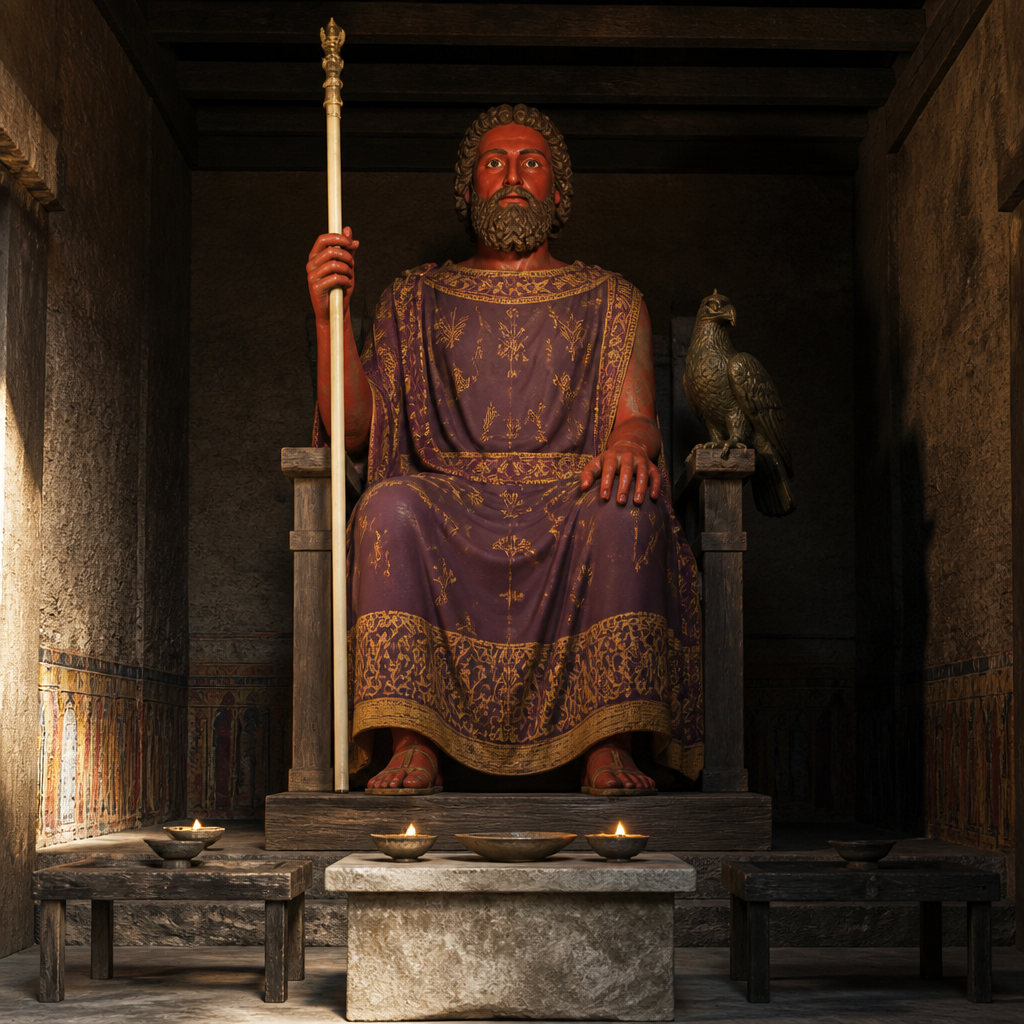
Before a triumph the man in the gilded chariot had his face painted. The pigment was minium, powdered cinnabar, the same expensive red mineral the censors contracted to have brushed onto the face of the Capitoline statue before every holy day, and Pliny found the custom old enough and strange enough to admit he could not explain it. The general wore the god’s own clothes, taken out of the temple wardrobe: the purple *toga picta*, the palm-embroidered tunic, the ivory sceptre. Livy calls it plainly, the regalia of Jupiter Best and Greatest. Whether the Romans thought the man had become the god for an afternoon is argued over to this day. What is not in doubt is that the costume was real, the paint was a line in the state budget, and the procession climbed the hill to give the spoils back to the owner of the wardrobe.
That is the shape of Roman Jupiter. Not a character with a biography but a proprietor, with an inventory. He came in versions, each doing one job, and the Romans kept them straight the way a modern city keeps its departments straight. Jupiter Feretrius took the arms stripped from an enemy commander killed in single combat. Jupiter Stator halted a rout. Jupiter Elicius was the one you drew lightning down from, which Numa was said to have managed and later kings to have botched fatally. Jupiter Fulgur was the lightning-strike itself, fenced off where it fell. Jupiter Lapis held the oath: the swearer took up a flint, said that if he lied knowingly the god should cast him out of house and city as he now cast the stone, and threw it.
The name is older than Rome. It is a vocative fossil, the form you use when calling out to someone: *Dyeu pater*, sky father, the same phrase Greek preserves as *Zeu pater*. The everyday Latin nominative wore away, so the god ended up with a suppletive paradigm, addressed as Jupiter and spoken about as Jove. The archaic form survived where language always survives longest, inside ritual. When the fetial priest concluded a treaty he called on Diespiter, not Jupiter, cut the pig’s throat with the flint, and asked the god to strike the Roman people the same way if Rome broke faith first, adding a clause that has no equivalent in any Greek prayer: strike so much the harder as you are greater in power and might.
The Capitoline temple was vowed by Tarquinius Priscus in a Sabine war and built by his successor, and when the diggers went down for the foundations they turned up a human head with the blood still fresh on it. The seers read it as a promise that Rome would be the head of Italy, and the hill kept the name. Two of the gods already occupying the site, Terminus the boundary-marker and Iuventas the goddess of the military age, refused to be moved by the ritual that clears ground, which was taken to mean Rome’s frontiers would never contract and her young men never run out. The temple was dedicated on the thirteenth of September, in the first year of the Republic, by Marcus Horatius Pulvillus, who drew the honour by lot from his colleague. It had three parallel rooms: Jupiter in the middle, Juno on his left, Minerva on his right. The roof-peak carried a terracotta Jupiter driving four horses, made by Vulca, an Etruscan sculptor from Veii; in 296 BC the aediles replaced it in bronze and laid bronze thresholds and silver vessels in the cella.
On the Ides of every month a white ewe lamb went up the slope of the citadel behind the flamen Dialis, and Ovid records the sacrifice in a single line of the calendar as though nobody needed it explained. The priest who made that offering lived under a body of prohibitions that Aulus Gellius copied out of the pontifical books. He could not ride a horse or look at an army in battle order. He could never swear an oath. He could wear no ring unless it was broken and stoneless, and no knot anywhere in his clothing or his cap. If a man in chains entered his house the chains had to be taken off and hauled up through the roof opening and dropped into the street. He could not touch or even name a she-goat, raw meat, ivy or beans, could not walk under a trellised vine, could not sleep three nights running away from his own bed, whose legs were smeared with clay. His hair and nail clippings were buried under a fruitful tree. Every day of his life was a holy day. If his wife died he ceased to be the priest, because the office belonged to the two of them together, and she had her own rules: no more than three rungs of a ladder, and no combing her hair when she went to the Argei. Not one of these has anything to do with a story. They describe a man kept permanently unbroken, uncut, unknotted and undead, which is what the god required in the person who handled him.
Everything a Roman magistrate did rested on Jupiter’s answer. Livy has the augur lead Numa up to the citadel, sit him on a stone facing south, mark out the sky with a curved staff, put a hand on the king’s head and ask: father Jupiter, if it is right that this man be king of Rome, give us clear signs inside the boundaries I have drawn. The signs came, and Numa was king. That procedure never stopped mattering. The auspices were Jupiter’s, magistrates only held them on loan, and a consul who took office under bad signs could be made to resign for it.
His grip on the calendar was just as concrete. Each year the consuls fixed the date of the Feriae Latinae on the Alban Mount, where forty-seven communities sent representatives, poured libations of milk, and shared out the meat of a single bull sacrificed in common to Jupiter Latiaris. No magistrate holding military command could leave the city for his province until it was over, and if any part of the rite was fumbled the whole thing had to be performed again at the offending community’s expense. A federal picnic on a hilltop functioned as a legal brake on the Roman army.
The temple of Jupiter Feretrius was the opposite of the Capitoline in every dimension. Romulus was said to have founded it after killing Acron of the Caeninenses and carrying the stripped armour back on a frame, and it stayed tiny, no more than fifteen feet along its longest side, roofless by the time Atticus persuaded Augustus to repair it. It held no image of the god at all: a sceptre and the flint the fetials used, and nothing else. In something like seven centuries only three men were held to have earned the spoils it was built for, and whether the second of them was a consul at the time became a political question under Augustus, because a serving governor had just claimed the same honour and was refused it.
The Greek Jupiter arrived late, and it is possible to date the arrival. In 217 BC, after Trasimene, the Sibylline Books prescribed a *lectisternium*, and six couches were laid in public for twelve gods arranged in pairs: Jupiter with Juno, Neptune with Minerva, Mars with Venus, Apollo with Diana, Vulcan with Vesta, Mercury with Ceres. That is the Roman pantheon being publicly restated as a Greek twelve under war pressure, in a single afternoon, by decree. Within a generation Ennius was writing Latin hexameters in which Jupiter presides over a council of gods debating Romulus’s promotion, and translating Euhemerus into Latin prose in which the same Jupiter is a dead king with a tomb on Crete. The myths on the Zeus page reached Rome through poets and through the emergency religious apparatus of the Second Punic War. The oath, the flint, the auspices and the flamen’s beans were already centuries old when they got here.
His powers follow from that. He can kill from the sky, and the mark he leaves has to be walled in. He can void an election, cancel a campaign, and unmake a treaty. He guarantees every promise a Roman makes to another Roman, which is why perjury was his business rather than a court’s. His limits follow from it just as tidily. He is procedural, and procedure can go wrong: a mistake in the words obliges the state to start again, and a Roman consulting him is not praying so much as filing. He never had the freedom of a god in a story, because the Romans had not given him one. When Decius Mus devoted himself and the enemy line to the underworld at the Veseris, he had to recite a list, and Jupiter is only the second name on it.
The Capitol itself burned three times, in 83 BC with the Sibylline Books inside it, in the fighting of AD 69, and again in AD 80, and each time it went back up richer, until Domitian’s version had Pentelic marble columns, gold-plated doors and gilded bronze roof tiles. The Romans rebuilt the temple faster than they rebuilt most of their own houses. They did not have a story about why they loved him. They had a receipt.
Frequently Asked Questions
Who was Jupiter in Roman mythology?
Jupiter was the chief god of the Roman state, worshipped as Jupiter Optimus Maximus in the great temple on the Capitoline Hill. He controlled lightning, the auspices that validated every Roman magistrate’s actions, and the force of sworn oaths. Rather than a single figure with one myth, he existed as a set of specialised cults, each with its own title, temple and function.
What is the difference between Jupiter and Zeus?
Zeus is a Greek god with an extensive myth cycle; Jupiter is a Roman cult with almost none of its own. The Roman material centres on law, oath-taking, augury and state ritual, and the Greek stories were attached to Jupiter only from about 217 BC onward, through Sibylline ritual reform and the poetry of Ennius. The two were formally paired in the public *lectisternium* held after the defeat at Lake Trasimene.
What was the flamen Dialis?
The flamen Dialis was Jupiter’s full-time priest at Rome, and he lived under an extraordinary set of prohibitions recorded by Aulus Gellius. He could not ride a horse, swear an oath, wear a knot, touch beans or raw meat, or sleep away from his own bed for three consecutive nights. The priesthood was held jointly with his wife, the flaminica, and ended automatically if she died.
What was Jupiter’s temple on the Capitoline Hill?
The temple of Jupiter Optimus Maximus was vowed by Tarquinius Priscus and dedicated in 509 BC by the consul Marcus Horatius Pulvillus. It held three parallel shrines, with Jupiter in the centre and Juno and Minerva on either side, forming the Capitoline Triad. It burned in 83 BC, AD 69 and AD 80, and was rebuilt more lavishly each time.
Why did Roman generals paint their faces red?
At a triumph the general wore Jupiter’s own regalia from the Capitoline temple and had his face coloured with red cinnabar, the same pigment applied to the god’s statue on holy days. Pliny records that painting the statue was a contract let by the censors, so the practice was a formal state expense. Ancient writers, Pliny included, admitted they did not know how the custom began.
Related Entries
Zeus, Tinia, Uni, Quirinus, Janus, Saturn, Vesta, Romulus, Remus, Aeneas, Faunus, Apollo, Capitoline Wolf, Lares, Juno, Minerva, Mars, Dyaus