
Daedalus
Also Known As: Greek Daidalos, Δαίδαλος; Latin Daedalus; the name sits inside the Greek word-family of daidalon, a cunningly worked thing, and daidallein, to work with cunning
Region/Culture: Southern Europe
Mythos: Greek Mythology, Roman Mythology
Primary Type/Nature: Heroes and Mortals
Mythical Attributes: He can build anything asked of him, from statues that appear to see and walk to a wooden cow convincing enough to fool a bull, and he has no gift at all for foreseeing what the thing will be used for.
Role in Mythos: He is the master craftsman of Greek myth, the man who built the Cretan Labyrinth and then had to get out of it.
Relation to Humans: He is entirely mortal, and every court that shelters him gets a public works programme and a corpse out of the arrangement. Athens tried him for murder, Crete imprisoned him, and Sicily used him to kill a visiting king in the bath.
The saw came off a fish. A boy of twelve in Athens turned over a spine the sea had left on the sand, counted the teeth running the length of it, and cut that same row into a strip of metal. Later he pinned two iron arms together so that one could stand still while the other swept a perfect circle. He was Daedalus’s apprentice and his sister’s son, and he was already better than his teacher. Not long after, he went off the edge of the Acropolis.
Everything Daedalus builds afterwards is built by a man who has done that.
Before the murder he was simply the best pair of hands in Attica. Diodorus places him in the Erechtheid line, son of Metion, and says his real innovation was movement. Sculptors before him carved figures with the eyes shut, the arms locked against the ribs and the legs pressed together, and Daedalus opened the eyes, parted the legs into a stride and swung the arms clear, and people standing in front of the results said the statues could see, and could walk. It is a small technical claim that quietly changes what a statue is for. Stone that has been given somewhere to look is no longer furniture.
The nephew threatened all of it. Diodorus names him Talos, says he studied under his uncle, invented the potter’s wheel and the saw, and was on course for a name larger than the man who taught him; he is more often called Perdix now, after the bird he became. Daedalus killed him. Caught in the act of burying the body, he said he was burying a snake, which is the kind of answer that sounds better in the moment than it does in front of the Areopagus, and the Areopagus convicted him. Ovid ends the fall differently. Minerva, who favours quick minds, caught the boy in mid-air and feathered him, and the partridge has kept low ever since, never perching on a branch or a high point, whirring along just above the soil and laying its eggs in sheltered ground, remembering the drop.
He killed the boy because the boy was better. None of the sources soften it.
Crete took him in because Crete did not care. Minos knew the name, made a friend of the exile, and the work Daedalus did for that household is the reason anyone still says it. Pasiphae, the king’s wife, conceived a passion for a bull, and Daedalus built her a hollow wooden cow on wheels; what came of that had the head and shoulders of a bull on the body of a man. Then he built the box to keep it in, a structure whose corridors, in Apollodorus’s phrase, perplexed the outward way. It has no bars anywhere in it. It is a prison made entirely of choices, all of them wrong.
Then Theseus arrived with the tribute, and Ariadne asked how a man might come back out. Daedalus told her about the thread. Virgil says he did it out of pity for the princess, which may be the only unpaid kindness in his file, and it cost him everything. Minos, learning whose advice it had been, shut him in his own labyrinth with his son Icarus.
He had built it, so he knew there was no way out along the floor. He went up.
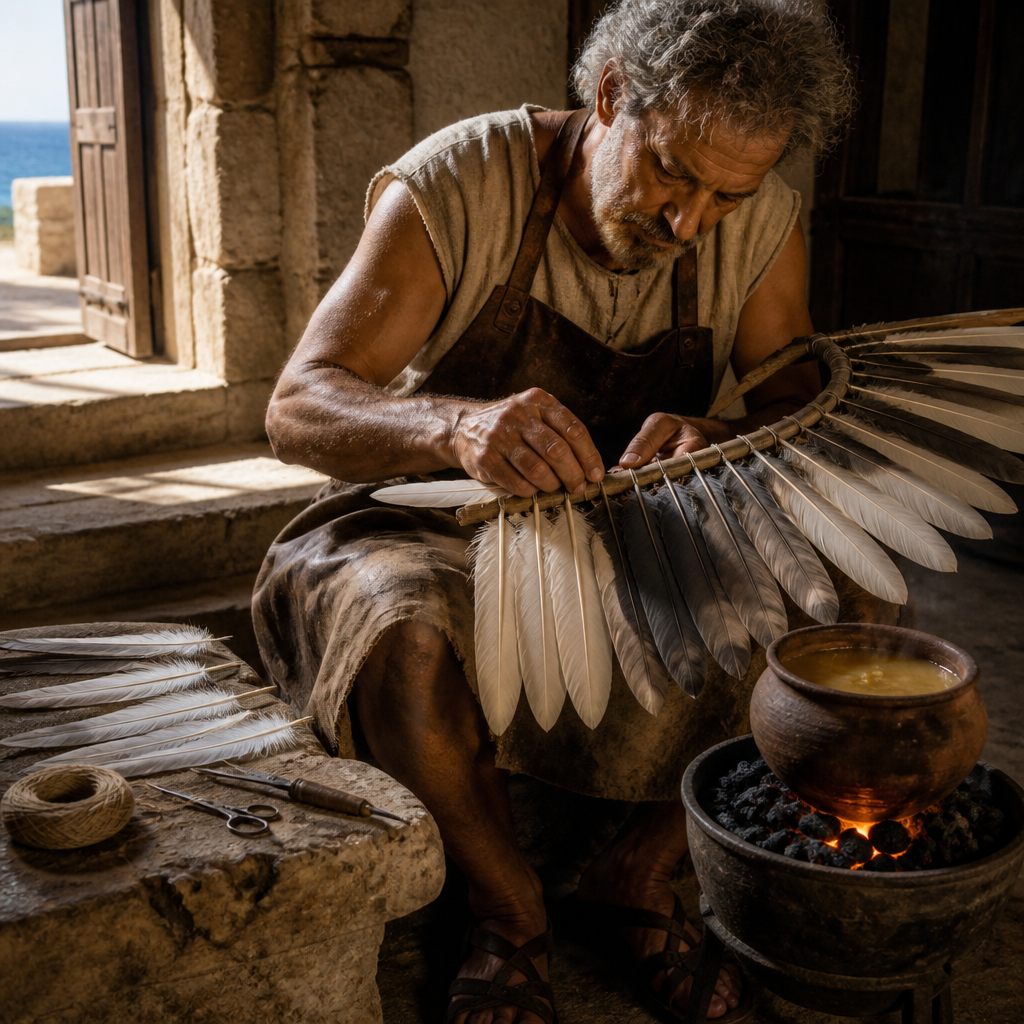
The wings are the most domestic scene in Greek myth. Feathers laid out shortest to longest like a rank of pipes, thread run through the middle of them, wax along the base, the whole assembly bent into a gentle curve to imitate a real wing. Icarus stood at his father’s elbow through all of it, laughing, snatching at the down that lifted in the draught, working the yellow beeswax soft with his thumb, handling the one object in the world built to keep him alive. Ovid says the old man’s cheeks were wet while he worked and his hands shook, and that he gave his son a kiss he would not get to give again. Take the middle way, he said. Too low and the damp will weigh you down, too high and the sun will scorch you. Do not steer by the Herdsman, or the Great Bear, or the drawn sword of Orion.
Underneath them a fisherman with a long rod, a shepherd leaning on his crook and a ploughman raising his eyes all watched two figures cross the sky and took them for gods.
The boy climbed anyway. The wax went soft, then ran, and he was beating bare arms against nothing, and the name in his mouth was his father’s when the water closed over it. Daedalus, no longer a father, circled and shouted for him, then saw feathers riding the swell and cursed the arts he had given his life to. He buried what he recovered, and the island took the boy’s name.
Diodorus, who has no romance in him, sets the flat version alongside it: Pasiphae supplied a ship, they sailed out, Icarus was careless coming ashore and drowned. He reports the flight as a marvel and lets the reader decide which story to keep.
Sicily held him longest, and the record there is oddly practical. King Cocalus received him at Camicus and made a friend of him, and Daedalus spent his exile as a civil engineer. He built a reservoir near Megaris that fed the river Alabon, a grotto at Selinus warmed so evenly that a man could sit and sweat in it without distress, a retaining wall at Eryx that widened the rocky ledge under the temple of Aphrodite, and a golden ram so exactly like a ram that it passed for one. Above all he built a city on a rock, reached by a stair so narrow that three or four men could hold it against an army, and Cocalus moved his treasury into it.
Minos came for him with a fleet and asked for his property back. Cocalus was courteous. He invited the king to talk, then invited him to bathe, and kept him in the hot water until he stopped moving, and afterwards explained that Minos had slipped and fallen in. That is the last thing Daedalus’s presence does to anyone.
Virgil gives him one more landfall. Coming north out of Crete he sets down at Cumae on the Chalcidian height, hangs his wings up for Apollo and builds the god a temple, and on its doors he carves his own life: Androgeos dead, the Athenian children counted out for the tribute, Pasiphae and the bull, the Minotaur, the maze, the thread going into the dark for Ariadne’s sake. Twice he began to work his son’s fall in gold. Twice the father’s hands went down. It is the only thing in the whole tradition he could not make.
What he has is not power, it is competence without limit, and the myth is arranged so that the two are never the same. He can solve any problem put to him and he cannot govern a single use of the solution. The cow produces the Minotaur. The Labyrinth becomes his own cell. The thread frees Theseus and jails its inventor. The wings work, which is the tragedy, because they work well enough to let a boy climb out of range of the advice. Even the fortress at Camicus does its job by helping a host boil a guest.
Whether there was ever a man at all is a live question. A Linear B tablet from Knossos, KN Fp(1) 1.3, records olive oil sent da-da-re-jo-de, to the Daidaleion, a sanctuary of Daidalos, centuries before any of the stories were written down. When Homer first uses the name it is not for wings but for a floor, the dancing ground Daedalus laid at Knossos for long-haired Ariadne, which Hephaestus copies onto the shield of Achilles. Sarah Morris, in Daidalos and the Origins of Greek Art, reads him less as a person than as a word that grew one, the daidala being the whole class of cunningly worked things, with the Levantine craftsman-god Kothar-wa-Hasis somewhere behind him and a Crete that had traded east for a thousand years as his natural home, until fifth-century Athens repatriated him and made him a citizen. When the Athenians took him back they took the murder with him.
Frequently Asked Questions
Who was Daedalus?
Daedalus was the master craftsman of Greek myth, an Athenian architect, sculptor and inventor who worked for King Minos of Crete. He built the Labyrinth that held the Minotaur, the wooden cow that made the Minotaur possible, and the feathered wings on which he and his son Icarus escaped the island.
Why did Daedalus kill his nephew?
Out of professional jealousy. His nephew, called Talos by Diodorus Siculus and more often Perdix today, was apprenticed to him and invented the saw after studying the spine of a fish, along with the compass and, in Diodorus, the potter’s wheel. Daedalus threw him from the Athenian acropolis, was caught burying the body, and was convicted of murder by the court of the Areopagus.
What did Daedalus build?
His known works run from the wooden cow he made for Pasiphae and the Labyrinth he built for the Minotaur, to a dancing floor at Knossos for Ariadne, a reservoir, a heated grotto and a temple wall in Sicily, a golden ram, and the fortress city of Camicus. Ancient writers also credited him with a revolution in sculpture: statues with open eyes, striding legs and free arms rather than the rigid figures made before him.
How did Daedalus escape from Crete?
In the famous version he made wings of feathers bound with thread and wax and flew out with Icarus, warning the boy to keep to a middle altitude. Diodorus Siculus preserves a plainer alternative in which Pasiphae gave Daedalus a ship and the pair escaped by sea. Either way Daedalus reached Camicus in Sicily alive and his son did not.
Was Daedalus a real person?
There is no evidence for a historical Daedalus, but the name is very old. A Linear B tablet from Knossos records an offering of olive oil sent to a Daidaleion, a sanctuary of Daidalos, and Homer’s first mention of him is as the maker of a dancing floor rather than of wings. Sarah Morris has argued that the figure grew out of the Greek word for cunningly worked things and out of contact with Near Eastern craftsman gods, before Athens claimed him as its own.
Related Entries
Icarus, Minos, Minotaur, Ariadne, Theseus, Cretan Bull, Talos, Hephaestus, Athena, Apollo, Arachne, Prometheus, Aeneas, Phaethon