
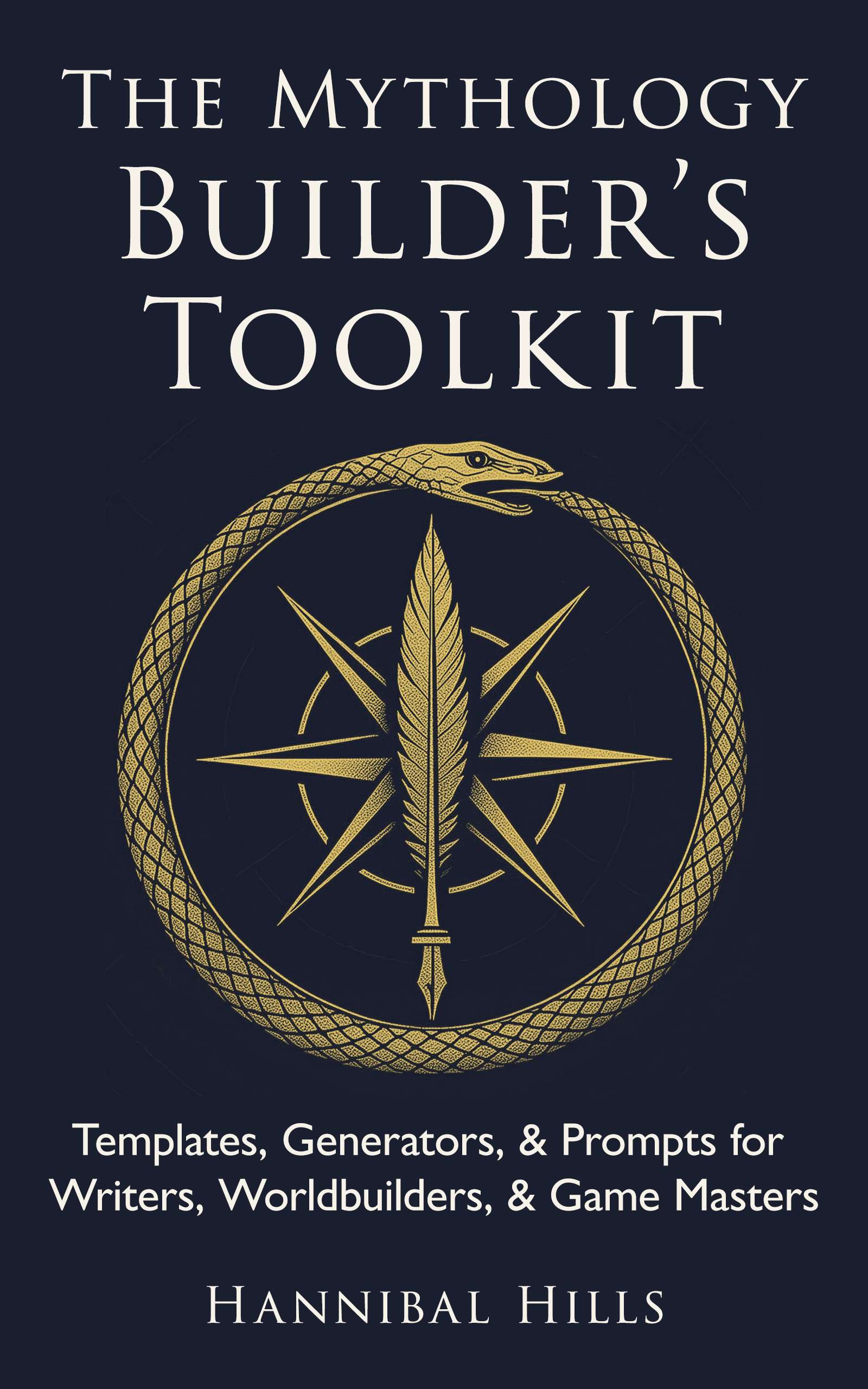
The Mythology Builder’s Toolkit
Templates, Generators, & Prompts for Writers, Worldbuilders, & Game Masters
By Hannibal Hills — Creator of Gods and Monsters
Available now in eBook, paperback, hardcover, and audiobook.
- eBook — $9.99
- Paperback — $14.99
- Hardcover — $19.99
- Audiobook — available on Libro.fm
A Workshop, Not a Textbook
Most mythology books want you to memorize. This one wants you to build.
The Mythology Builder’s Toolkit is a hands-on creative guide for writers, game designers, teachers, and worldbuilders who want to make their own mythologies — not study someone else’s. Nine chapters, each built as a workshop: tools, archetypes, worked examples, and a creative dare at the end of every one. By the time you finish, you’ll have the pieces to build a complete mythic cosmos from the creation myth down to the village ghost story.
This isn’t a cookbook. There’s no sacred order and no required ingredients list. Take what you need, ignore what you don’t, and build from the ground up — or jump straight to the chapter that solves the problem you’re stuck on today.
What’s Inside
Nine chapters, 211 pages, and one running mythology that grows alongside you as you read.
Chapter 1 — Genesis Engine
How worlds begin. Creation myths, the six archetypes of cosmic origin, and the Shape of the Cosmos: how the act of making determines the architecture of what’s made. If the world was torn from a giant’s corpse, the underworld might be the giant’s gut. If it was sung into being, there might be places where the song went flat.
Chapter 2 — Pantheon Builder
Gods, spirits, and the Divine Spectrum — the full continuum from the deity who made the sun to the ghost who haunts the kitchen. Most worldbuilding books separate gods, spirits, ancestors, and the hungry dead into different chapters. This one builds them as a single ecosystem, because in every living mythology they already are one.
Chapter 3 — Bloodlines & Legacy
Ancestry as a political weapon. Generational curses, inherited destinies, sacred talismans, and the Adopted Line — the archetype that demolishes the assumption that blood determines belonging. The dead aren’t sleeping. They’re arguing about the silverware.
Chapter 4 — The Hero & The Villain
Built together, not apart. The Mirror Framework: shared origin, divergent choices, complementary wounds, and a resolution that costs both sides. The villain is the truth the hero doesn’t want to face, given a body and a voice and a plan.
Chapter 5 — Trickster Creation Kit
The chapter that breaks its own rules. Shapeshifters, sacred fools, boundary-crossers, and the figure your mythology is afraid of. A world without tricksters is a world trapped in its own propaganda.
Chapter 6 — Monster Ecologist
Creatures, undead, and the Hunger Principle: every monster worth building wants something beyond what it eats, and what it wants reveals the wound in the world that made it necessary. Build them as an ecology — interconnected, co-dependent, dangerous, and alive.
Chapter 7 — Relics & Sanctums
Objects and places of power, built as pairs. The Pairing Principle: every relic implies a sanctum, every sanctum hungers for a relic. Excalibur needs the stone. The Grail needs the chapel. Separate them and both diminish.
Chapter 8 — The Living Myth
Festivals, curses, and prophecies — the social skeleton of a mythology. The part that shows up on the calendar and changes what people eat, who they marry, and which roads they won’t walk after dark. This is where myth stops being backstory and starts being daily life.
Chapter 9 — Quest & Apocalypse
How the journey and the ending are the same story at different scales. The Scale Shift: every quest is a small apocalypse, every apocalypse is someone’s quest. The chapter that closes the circle.
The Loom
Across the book, one mythology is built from scratch.
It begins in Chapter 1 — a weaver, a grief, a song that becomes a world — and accumulates chapter by chapter, growing more complicated, more contradictory, and more alive as each toolkit adds a layer. By the end of Chapter 9, you’ll have watched a complete myth cycle take shape: creation, gods, bloodlines, heroes, tricksters, monsters, relics, prophecy, quest, and apocalypse.
It’s called the Loom, and it appears at the end of every chapter in a register all its own — mythic, spare, and strange. Think of it as the book practicing what it preaches. The invitation is open to build alongside it, starting your own myth from scratch and adding a layer with every chapter.
Who This Book Is For
If you’ve felt the itch — the urge to create, to make sense of the world, or just to mess with it a little — this book is for you.
Maybe you’re a novelist building a world that needs a pantheon. A game designer who needs monsters with real hunger behind them. A Game Master whose campaign deserves a mythology that feels older than the session notes. A teacher trying to spark something in a restless classroom. A screenwriter, a poet, or just someone who’s always been myth-curious and never found the right doorway in.
You don’t need credentials. You don’t have to be a classicist or a cultist, fluent in dead languages or up to your elbows in Joseph Campbell. The only requirement is a willingness to poke at the world and see what answers bubble up when you tell a new story.
This book is for the architects and the tinkerers, the epic dreamers and the meticulous worldbuilders, the skeptical and the wonder-struck alike. Whether you want to build a cosmos from scratch, breathe new life into an ancient legend, or just kick the tires of your own imagination — the forge is open.
About the Author
Hannibal Hills is the creator of Gods and Monsters, one of the largest mythology encyclopedias on the web — a growing collection of over 2,300 entries covering gods, monsters, spirits, and mythical beings from more than 100 cultural traditions worldwide. His daily Substack, Mythology: Gods and Monsters, delivers myth to over 50,000 subscribers.
What started as a personal obsession with hunting down obscure myths grew into a years-long research project spanning every inhabited continent. He lives in North Carolina, where the local folklore is underrated.
Get the Book
The Mythology Builder’s Toolkit is available now in eBook, paperback, hardcover, and audiobook.
- eBook — $9.99
- Paperback — $14.99
- Hardcover — $19.99
- Audiobook — available on Libro.fm
211 pages · Published by Royal Wave Media · ISBN 978-1-956122-91-6 (eBook) · 978-1-956122-92-3 (paperback) · 978-1-956122-93-0 (hardcover)