
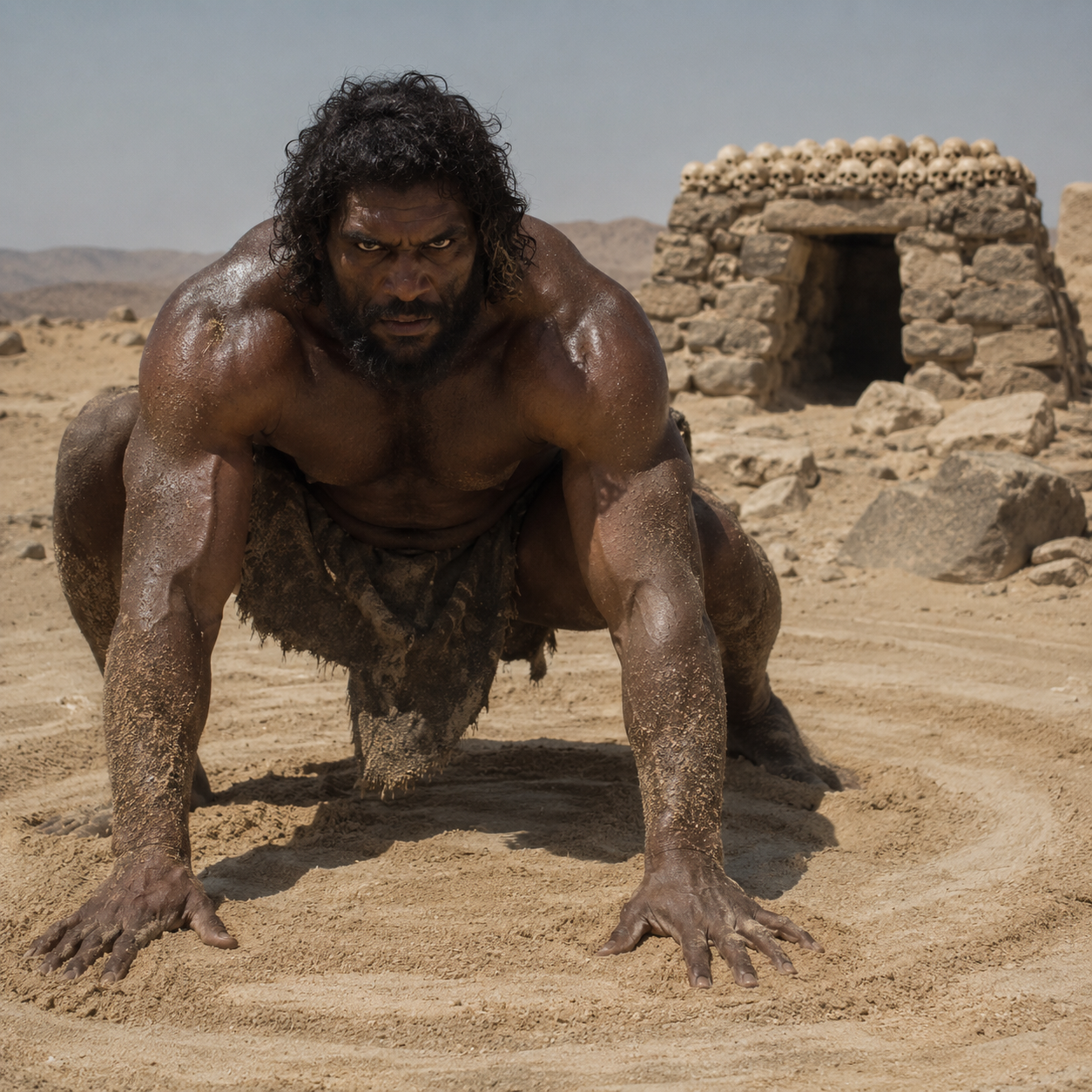
Antaeus (Greek: Antaios)
Region/Culture: Southern Europe
Mythos: Greek Mythology
Primary Type/Nature: Monsters and Beasts
Mythical Attributes: Antaeus possessed invincible strength that renewed itself the moment any part of his body touched the earth, his mother Gaia.
Role in Mythos: He was the man-killing wrestler giant of Libya whose defeat became one of the most famous side adventures of Heracles.
Relation to Humans: Antaeus forced every traveler who crossed his territory to wrestle him to the death, and he roofed a temple of Poseidon with the skulls of the losers. After his death, the people of Tingis in Mauretania claimed descent from his widow Tinga and displayed his enormous tomb for centuries.
In the Libyan interior, somewhere past the last reliable well, there stood a shrine to Poseidon roofed with human skulls. Travelers could see it from a long way off, the domes white and regular as cobblestones in the hard light, and most of them understood the local custom before anyone had to explain it. The builder was Antaeus, a giant who collected the heads of everyone he wrestled. He wrestled everyone.
The Greeks knew exactly where his strength came from, and it was the kind of pedigree that explains a great deal. His father was Poseidon, god of the sea and of earthquakes. His mother was Gaia, the Earth herself. Antaeus never really left her. Every time his foot, his shoulder, or his sprawled back touched the ground, his mother fed strength back into him, fresh and undiminished, the way a spring refills a cup. Throwing him down, the usual way to win a wrestling match, was therefore worse than useless. A thrown Antaeus stood up stronger than the one who had just been standing.
He made a living arrangement of this gift. Pindar set him at Irassa, deep in the Libyan country, where he waited beside the caravan routes the way other hazards wait, like thirst or sandstorms, but with rules. A merchant crossing his ground would be stopped, stripped, and steered into a circle of raked sand. Antaeus would stoop first, pressing both palms flat into the hot grit in something between a stretch and a prayer, and rise looking somehow larger. Then the match began, and it ended the way all of them ended, with one more skull for the roofline.
He was enormous even by the standards of a mythology that did not ration its giants. When the Roman general Sertorius reached Tingis centuries later, Plutarch says, the locals showed him the burial mound of Antaeus, and the skeptical Roman had it opened. Inside lay a skeleton sixty cubits long, roughly ninety feet of dead wrestler. Sertorius was horrified, sacrificed to the giant, and had the mound sealed back up with honors. Greek painters imagined the living Antaeus as everything a trained athlete was not: massive through the chest and shoulders, shaggy, sun-blackened, his muscle heaped on like a beast’s rather than shaped in a gymnasium. He fought low to the ground, for obvious reasons. Plato ranked him beside Cercyon as a pioneer of wrestling’s nastier tricks, which from Plato counts as a kind of left-handed respect.
He enters Greek poetry not long after Greeks themselves began settling the North African coast in the seventh century BC, which is probably not a coincidence. Whether the colonists invented him outright or pulled a local Berber strongman-figure into their own mythology, the stories disagree, and the people of Mauretania later told the tale as their own, with their city and their kings descended from his household.
The famous match came to him. Heracles passed through Libya hunting the golden apples of the Hesperides, his eleventh labor, and Antaeus offered him the customary welcome. Lucan gives the fullest account of what followed. Heracles oiled his limbs in proper Olympic fashion; Antaeus poured hot sand over his own body, dressing himself in his mother. They closed, and the hero quickly found that everything he knew about wrestling had stopped being true. He threw the giant; the giant rose refreshed. He threw him again, harder, and the desert floor handed his opponent back like a debt collector with interest. Some tellings have Athena at the edge of the sand whispering the answer. Most let Heracles work it out himself, mid-fight, breathing dust and watching a beaten man get stronger.
The answer was the lift. Heracles wrapped his arms around Antaeus and hauled him into the air, feet clear of the ground, and held him there. The giant kicked at nothing. The strength ran out of him like water from a cracked jar, with no earth beneath him to refill it, and Heracles squeezed until the ribs went and the breath after them. Heracles held him up until he died. It is the rare Greek monster story whose solution is not a sword or a trick of fire but a single piece of insight applied without mercy.
The aftermath spread far beyond the sand circle. Heracles took the giant’s widow, Tinga, and fathered Sophax, who founded the city of Tingis, modern Tangier, and gave the later kings of Mauretania a double pedigree of giant and hero. The tomb at Tingis kept its own rule: dig earth away from the mound and rain would fall, the locals said, and would not stop until the hole was filled again. Dante found a use for Antaeus more than a millennium later, posting him at the rim of Hell’s lowest circle, unchained where his fellow giants are bound because he had skipped the war against the gods, and polite enough, with some flattery, to lower two poets gently into the ice.
His power was as close to absolute as the myths allow. On the ground he could not be exhausted, could not be worn down, could not lose, and the skull roof at the temple was a tidy record of how that arithmetic worked out for ordinary men. But it was all one trick. His strength was borrowed, never owned, and it stayed home when he left the floor. Lifted into the air, the unbeatable son of the Earth was just a very heavy man, dying in a stranger’s arms a few feet above the only thing that had ever loved him.
Frequently Asked Questions
Who is Antaeus in Greek mythology?
Antaeus is a giant of Greek mythology, the son of the sea god Poseidon and the earth goddess Gaia, who lived in Libya in North Africa. He forced every traveler who crossed his land to wrestle him to the death and used the skulls of his victims to roof a temple to Poseidon. He was finally defeated by the hero Heracles.
Why was Antaeus invincible?
Antaeus was invincible because his mother was Gaia, the Earth, and his strength renewed itself whenever any part of his body touched the ground. Throwing him down in a wrestling match only made him stronger, since each fall let him draw fresh power from his mother.
How did Heracles defeat Antaeus?
Heracles defeated Antaeus by lifting him completely off the ground, cutting him off from the earth that restored his strength, and crushing him in a bear hug while he hung in the air. Heracles encountered the giant while traveling through Libya during his eleventh labor, the quest for the golden apples of the Hesperides.
Where was Antaeus’s tomb?
The tomb of Antaeus was shown at Tingis, modern Tangier in Morocco, for centuries. According to Plutarch, the Roman general Sertorius had the mound opened, found a skeleton sixty cubits long, and was so shaken that he resealed it with full honors. Local tradition held that removing earth from the mound caused rain that would not stop until the hole was refilled.
Does Antaeus appear in Dante’s Inferno?
Yes. In Canto 31 of the Inferno, Antaeus stands at the rim of the ninth circle of Hell and lowers Dante and Virgil down to its frozen floor. Unlike the other giants there, he is unchained, because he took no part in the giants’ war against the gods.
Related Entries
Heracles (Hercules), Poseidon, Gaia, Athena, Hesperides, Atlas, Gigantes, Geryon, Cacus, Typhon, Nemean Lion, Theseus, Pygmy, Anak, Jentil